
In 1797 the Senate approved, 23–0 with nine senators not voting, a treaty stating that “the government of the United States of America is not in any sense founded on the Christian Religion.” President John Adams signed it, newspapers printed it in full, and no record of any objection survives. Most Americans were Christians; the government they built avoided making religion the source of its authority.Last checked October 2026
This page looks at one document. For the full record on whether America was founded as a Christian nation, including the Constitution, the First Amendment and the states’ own churches, see our overview of the claim.
Growing up in church, many of us developed a quiet certainty about America’s origins. The idea that the United States was explicitly founded as a Christian nation wasn’t something we remember learning. It was simply part of the world we inherited. For me, it seemed as natural and unquestionable as the phrase “one nation under God” in the Pledge of Allegiance. Although those words were not added until 1954, they have come to feel to many Americans as though they had always been there. The idea of America as a Christian nation settled into our understanding of history in much the same way.
I don’t remember consciously adopting that belief. In the evangelical circles I grew up in, it was simply part of the cultural landscape. In church, it wasn’t presented as an argument or even as a distinctive viewpoint. It was treated as an obvious fact about American history.
But stepping away from those inherited assumptions and opening the archives reveals a much more complicated picture. The founders left behind thousands of pages explaining what they intended to create. Sometimes, the most revealing evidence isn’t found in what they passionately proclaimed, but in what they deliberately chose not to write into law.
To understand what the founders actually built, we have to examine what they legally codified.
Setting the Scene: The Senate Floor in 1797
Let’s step back to the year 1797. George Washington has just retired to Mount Vernon, and John Adams has taken the oath of office as the second president of the United States. A new piece of foreign policy arrives at the Senate: The Treaty of Tripoli.
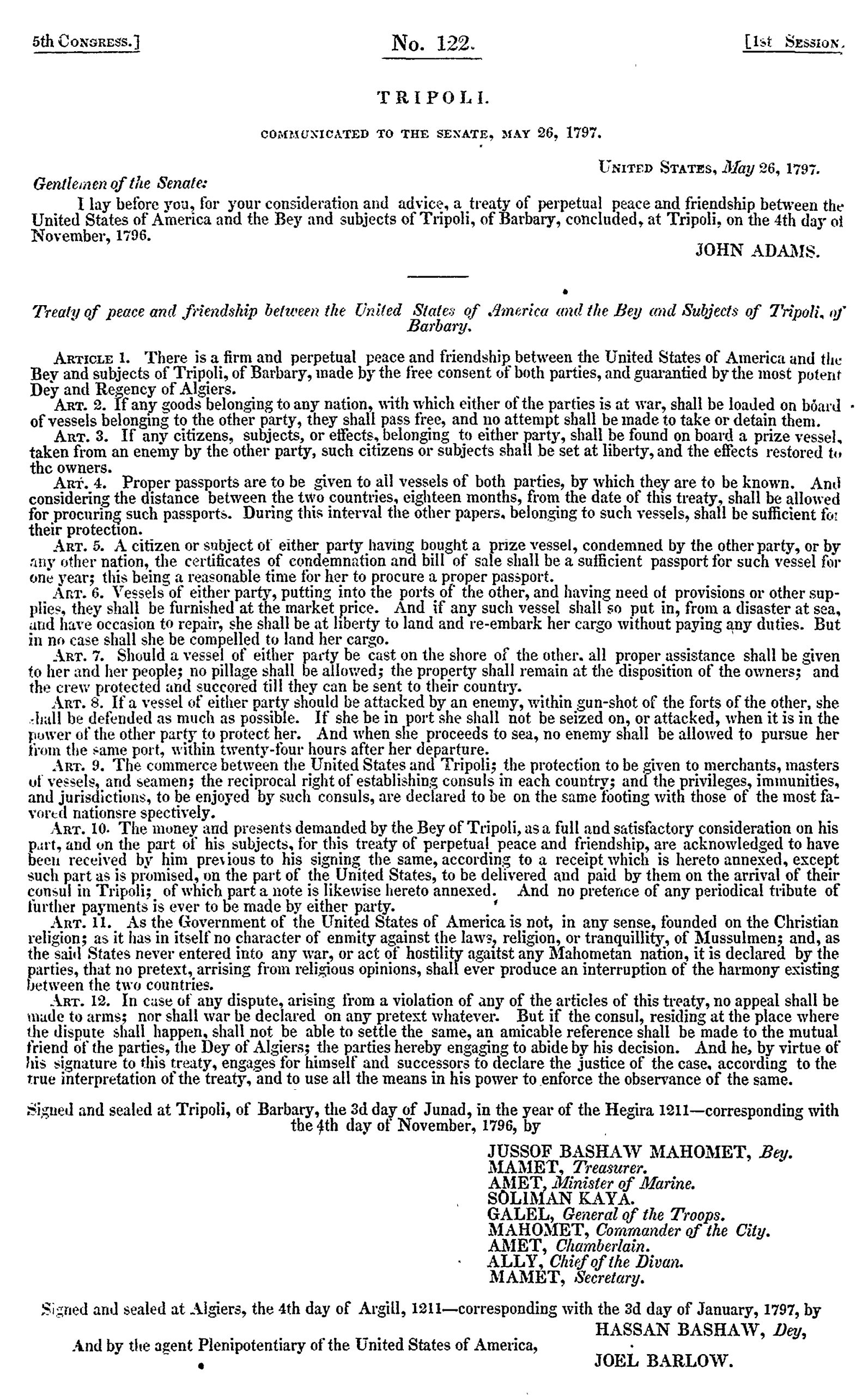
This wasn’t a secret backroom deal or a classified diplomatic cable. The entire treaty was read aloud on the Senate floor, and printed copies were distributed to every senator. Within days it was published in full in the newspapers: the June 17, 1797 edition of Philadelphia’s Gazette & Universal Daily Advertiser printed all twelve articles, and two New York papers reprinted it. Anyone who bought a paper on the street could read exactly what their new government had agreed to.
The Senate, which included men who had helped create the new government and fought for American independence, took a vote. On June 7, 1797, the Senate approved the treaty 23–0, with nine senators not voting (twenty-three of the thirty-two sitting senators were present). The historian Brooke Allen notes it was only the third unanimous vote in the Senate’s history to that point. There is no record of any debate or objection. Three days later, on June 10, John Adams, a man whose personal religious convictions are well documented, signed it and proclaimed it the law of the land.
The Unanswerable Question
So, what did this heavily publicized treaty, approved without a single recorded objection, actually say?
The primary purpose of the treaty was securing the safe passage of American merchant vessels and protecting them from attacks by North African pirates. But within this routine diplomatic agreement is Article 11, which contains this exact phrasing:
“As the government of the United States of America is not in any sense founded on the Christian Religion…”
There’s nothing ambiguous about this line. The meaning is quite clear. But it brings us to a historical question that the “Christian nation” narrative struggles to answer: If the founders understood the United States to be fundamentally and legally a Christian nation, why did no one object?
Where were the protests from those who believed the treaty contradicted the nation’s identity? Where were the dissenting votes from deeply religious senators? Why did John Adams approve a document that, under that interpretation, would have misrepresented the very nature of the government he helped lead?
The silence is the evidence. The men in that room didn’t object because the statement wasn’t controversial to them. It wasn’t a betrayal of their faith. It was simply a statement of constitutional fact. The government was designed to be entirely separate from the religion its citizens practiced.
And the treaty didn’t stand alone in saying so. The Constitution the Senate was working under never mentions God, Jesus, or Christianity in its articles. (The only nods are customary: Article I excuses Sundays from the president’s ten-day window to veto a bill, and the signing line dates the document “in the Year of our Lord” 1787.) The only two places it addresses religion directly are both fences against it: Article VI forbids any religious test for public office, and the First Amendment bars the government from establishing a religion. The Treaty of Tripoli didn’t invent a new idea about the American government. It restated, in a sentence, the same thing the founding document had already built into its structure.
Engaging the Counterargument: The Diplomatic Defense
If you have dug into this topic before, you may have heard a counterargument. Organizations like WallBuilders, led by figures like David Barton, rightly point out that we shouldn’t read history in a vacuum.
They argue that the famous phrase is only the opening clause of a longer sentence. Their defense is that this phrasing was merely diplomatic flattery. Because the United States was negotiating with the Muslim powers of the Barbary States, the founders needed to assure the Pasha of Tripoli that America was not a European crusader state coming to wage a holy war.
This is a fair point, and it provides historically accurate context. The language was meant to ease tensions and clarify American foreign policy to a Muslim leader. It was a diplomatic maneuver. Critics also note that the 1805 treaty that replaced this one dropped the line. That is true, but leaving a sentence out of a later treaty is not the same as repudiating it, and no one in 1797 objected to it.
Why the Defense Falls Short
However, conceding that it was diplomatic language does not change the ultimate reality of what occurred. Under the U.S. Constitution, a ratified treaty becomes the supreme law of the land.
The men who founded the United States were fiercely protective of their new republic. They had just fought a grueling, bloody war for independence and spent months sweating in a room in Philadelphia to hammer out their exact legal identity. Does it make sense that these men would legally codify a fundamental lie about the very nature of their government just to flatter a North African ruler?
If the U.S. government truly was founded on the Christian religion, signing a treaty stating the exact opposite would have been a remarkable contradiction. Political and moral perjury. It would mean that the nation’s highest officials knowingly placed a false statement into the law of the land for diplomatic convenience.
That interpretation requires us to believe that Adams and the Senate were willing to misrepresent the fundamental nature of the government they had just created. The historical record provides little evidence that they viewed the matter that way.
The Second Objection: “Article 11 Isn’t in the Arabic”
There is a more technical defense worth raising, because it is the strongest one and because a careful reader will eventually encounter it. Some “Christian nation” advocates point out that Article 11 does not appear in the surviving Arabic version of the treaty. In the place where Article 11 sits in the English text, the Arabic document contains something else entirely: a letter from the Dey of Algiers to the Pasha of Tripoli. On its face, this sounds like it might unravel everything.
It doesn’t, and the reason is a matter of record. The version negotiated and ratified by the United States was the English translation prepared by Joel Barlow, the American consul. That English text is what Adams submitted to the Senate, what the senators read on the floor, what they voted on, and what Adams proclaimed as law. Hunter Miller, the State Department scholar who edited the definitive edition of United States treaties, put it plainly: the Barlow translation is the one submitted to the Senate, the one printed in the Statutes at Large, and the text that in the United States has always been treated as the treaty.
So the discrepancy is real, but it changes nothing about the American side of the story. Whatever a scribe in North Africa did or didn’t write in Arabic, the government of the United States adopted the English words, read them aloud, voted on them, and made them law, without objection. The question the claim still can’t answer is the same one we started with: why did no one in that Senate blink?
The Takeaway
Pointing to the Treaty of Tripoli isn’t meant to erase the importance of religion in early America. The United States was overwhelmingly populated by Christians, and religious beliefs shaped the culture, values, and daily lives of many citizens.
But there is a profound difference between a nation composed of many Christians and a government legally founded on the Christian religion.
The Treaty of Tripoli is one of many documents from the founding era that complicates the modern claim that America’s status as a Christian nation was universally understood and legally established. The founders left behind an extensive documentary record. When we examine those records, we find a government that protected religious belief while deliberately avoiding making religion the source of its authority.
Looking honestly at these documents isn’t about attacking faith. It’s about ensuring that our faith isn’t being co-opted by a political narrative that doesn’t hold up to the light of history. When we are willing to check our assumptions against the actual records our founders left behind, we honor both our intelligence and our integrity.
Sources
- The treaty itself, full text and ratification record: Treaty of Peace and Friendship, Signed at Tripoli November 4, 1796. The Avalon Project, Yale Law School. (This is the primary document. Article 11 appears here in full, along with Adams’s proclamation.)
- The Senate vote and floor reading: Journal of the Executive Proceedings of the Senate of the United States, Fifth Congress (Congress.gov, Vol. 1; entry for Wednesday, June 7, 1797). Yeas 23, no nays recorded; the other nine of the thirty-two senators did not vote. Ratified and proclaimed June 10, 1797.
- Newspaper publication: The Philadelphia Gazette & Universal Daily Advertiser, June 17, 1797, which printed the treaty in full including Article 11; reprinted in two New York papers.
- On the Arabic text and the authority of the Barlow translation: Hunter Miller, ed., Treaties and Other International Acts of the United States of America, Vol. 2 (Government Printing Office, 1931), notes to the Tripoli treaty (reproduced by the Avalon Project).
- On the vote’s place in Senate history: Brooke Allen, Moral Minority: Our Skeptical Founding Fathers (Ivan R. Dee, 2006).
- Image: “Treaty of Tripoli as communicated to Congress, 1797,” printed English text submitted to the U.S. Senate. Public domain (work of the U.S. federal government). Wikimedia Commons, File:Treaty_of_Tripoli_as_communicated_to_Congress_1797.png.
Every factual claim on this page can be checked against the documents above.