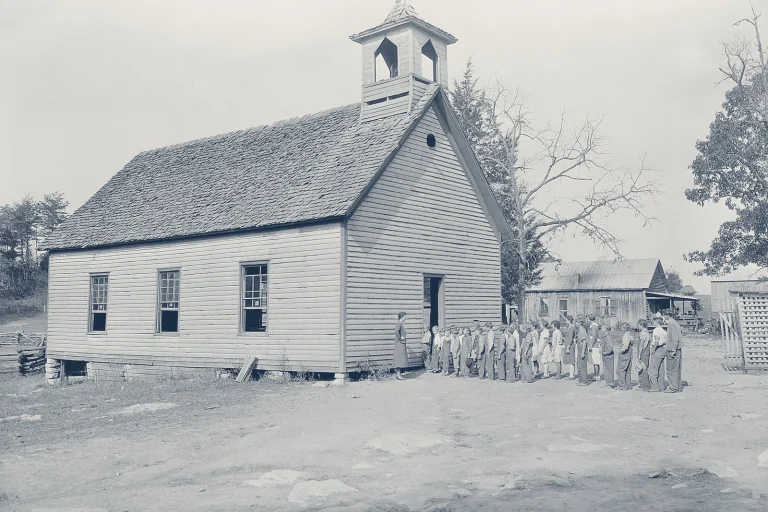
Starting in January, kids in Alabama history classrooms will look up and see a poster titled “Historical Truths: The Ten Commandments and America’s Founding Documents.”
Alabama’s law requiring it, Senate Bill 99, took effect on October 1, 2026. The posters are due starting January 1, 2027, in grade 5–12 classrooms where U.S. history is regularly taught, and in a common area of most schools, as long as donated posters or money are available.
If you’re thinking, “Didn’t Texas just do something like this?” you’re right. Louisiana, Arkansas, Texas and now Alabama have all passed laws putting the Ten Commandments in public schools. It can look like a string of unrelated local stories. It’s really one story, and we’ll get to that. First, the poster.
What makes Alabama’s poster different
Texas requires the Ten Commandments by themselves. Alabama’s poster surrounds them with a short history lesson: a quote from John Quincy Adams, plus summaries of the Mayflower Compact, the Northwest Ordinance, the Declaration of Independence and the preamble to the Constitution.
The message is that the commandments and America’s founding go together. That’s a claim about history, so we checked it.
First, a fair hearing for the people behind it. Supporters say the Ten Commandments helped shape Western law and that students should know the religious language in early American documents. Rep. Mark Gidley, who carried the bill in the Alabama House, said it was about “restoring the knowledge to our students of the foundational historical precedent that really created this nation.” The poster also includes a disclaimer, and it deserves credit for it: it quotes the Alabama Constitution’s promise that “no religion shall be established by law” and says choices about faith are “left to students and their families.”
The John Quincy Adams quote: real, but stretched
The poster says Adams wrote to his son in 1813 that “The Law given from Sinai” (which the poster explains as “in other words, the Ten Commandments”) “was a civil and municipal as well as a moral and religious Code.”
Adams really wrote that, and you can read the whole letter yourself at Founders Online. In the letter, though, “the Law given from Sinai” means the entire law of Moses, the hundreds of rules in the first books of the Old Testament. His very next sentence says that law included many statutes “adapted only to that time.” Adams does get to the Ten Commandments later in the letter, and he sorts them himself: four religious laws, two moral ones, and four that belong to criminal law.
So the poster takes a line about the whole law of Moses and presents it as a line about the Ten Commandments. That’s close to Adams’s view, but it’s not what the sentence says. It also helps to know the source: a private letter to his son, written 37 years after the Declaration, by a man who wasn’t one of the framers.
The Mayflower Compact: a colonial document
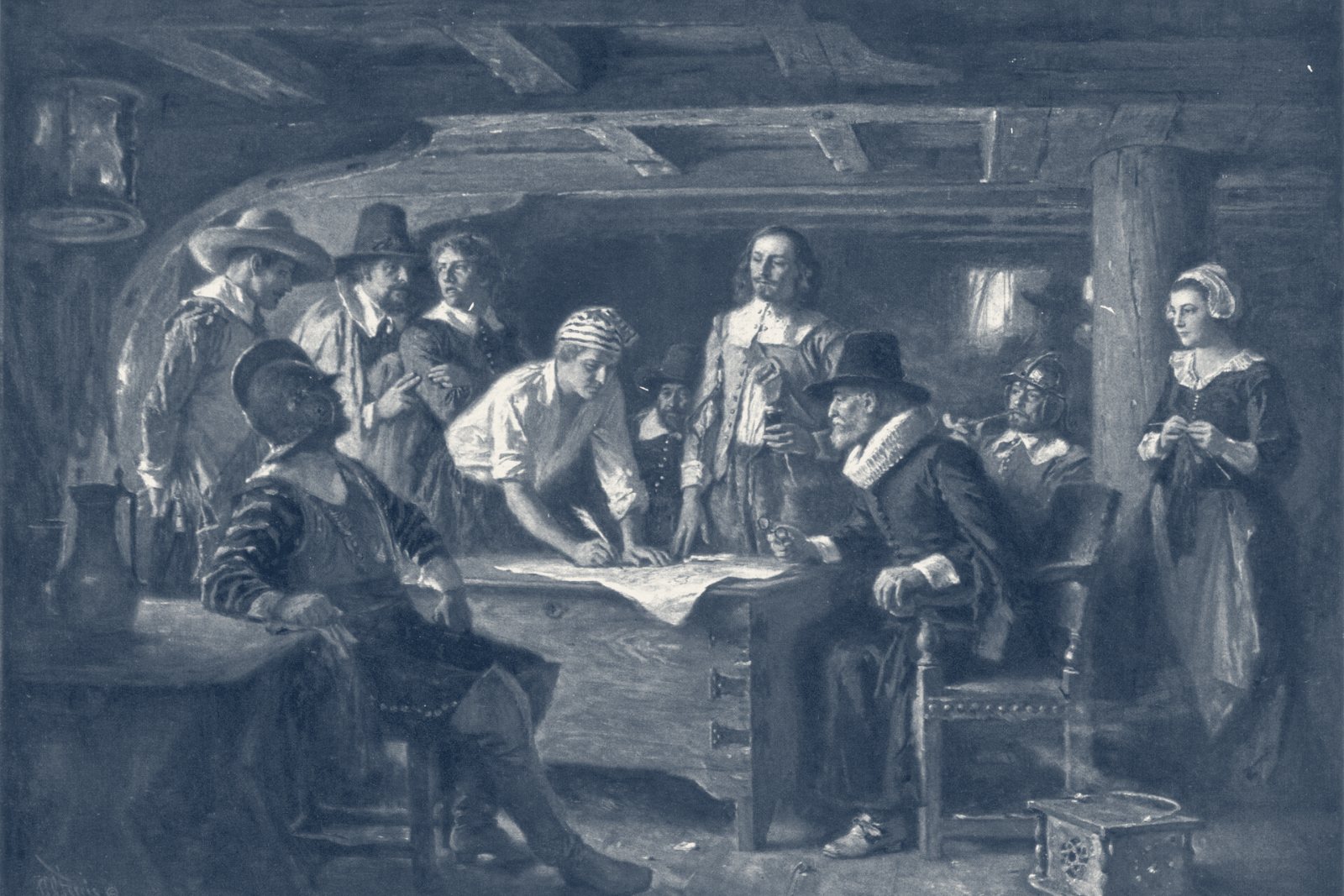
The poster calls the 1620 Mayflower Compact “America’s first written constitution.” The Compact does open “In the Name of God, Amen,” and its signers said their voyage was for the “Advancement of the Christian Faith.” All true.
Read a little further, though. The signers call themselves “Loyal Subjects of our dread Sovereign Lord King James.” These were English subjects starting an English colony, 156 years before the United States existed. Many colonies had official state churches. That’s exactly why it matters which era you’re quoting, and we dig into it on our page about why the colonies aren’t the founding.
The Northwest Ordinance: the poster leaves out the best part
The poster quotes the 1787 Northwest Ordinance: “Religion, morality, and knowledge, being necessary to good government and the happiness of mankind, schools and the means of education shall forever be encouraged.” That quote is exact.
What the poster skips is Article 1 of the same document, which says no peaceful person “shall ever be molested on account of his mode of worship or religious sentiments.” The same lawmakers encouraged religion and protected everyone’s freedom of worship, in one document. The poster gives you half of it.
The Declaration and the Constitution
The poster quotes the Declaration (“endowed by their Creator”) and the Constitution’s preamble accurately. Neither one mentions the Ten Commandments. The Constitution doesn’t mention God at all. Its only references to religion are a ban on religious tests for federal office, a “Sundays excepted” line about presidential vetoes, and the customary date at the end: “in the Year of our Lord.”
So why does a poster matter?
Here’s where the dots connect. The belief that America was built on the Ten Commandments is one of the core ideas of what researchers call Christian nationalism: the belief that America is, or should be, a Christian nation, and that its laws and government should be built around that identity. Putting the commandments on classroom walls is one of the most visible ways that belief is becoming law right now.
You don’t have to be against the Ten Commandments to have questions about that. Many Christians, Baptists especially, have a long tradition of believing faith does better when government stays out of it. And if a poster is going to teach kids history, the history should be right.
This argument isn’t new, either. Kentucky tried something similar decades ago, calling the commandments “the fundamental legal code of Western Civilization and the Common Law of the United States.” The Supreme Court struck down Kentucky’s posters in Stone v. Graham (1980). Supporters of the new laws say the Court changed the rules in 2022, and that question is now headed back to the Supreme Court.
What happens next
As of October 13, we haven’t found a lawsuit against Alabama’s law. Because the posters aren’t required until January, a challenge may have to wait until they actually go up. That’s what happened in Louisiana. The bigger fight right now is over the Texas and Louisiana laws, which are both waiting on the Supreme Court. We walk through those cases in Ten Commandments in classrooms: what’s going on, and why now?
The bottom line: early Americans used biblical language all the time, and the poster’s quotes show that. Whether the Ten Commandments were the legal foundation of the United States is a different question, and the founding documents themselves say much less about it than the poster does.
Related claims: America was founded as a Christian nation · The colonies are not the founding · Separation of church and state isn’t in the Constitution
Go deeper: The Bible gives the Ten Commandments twice, and Jews, Catholics and most Protestants count and word them differently. Our claim page “Which Ten Commandments?” lays out the versions and what the Texas poster chose.
Sources
- Alabama Senate Bill 99 (2026), enrolled text, including the required poster
- John Quincy Adams to George Washington Adams, January 10, 1813, Founders Online
- The Mayflower Compact (1620) and the Northwest Ordinance (1787), Avalon Project, Yale Law School
- U.S. Constitution, transcript, National Archives
- Stone v. Graham, 449 U.S. 39 (1980); Kennedy v. Bremerton School District (2022)
- Alabama Reflector, “Alabama Legislature gives final approval to bill mandating Ten Commandments school displays,” April 10, 2026
Spotted an error? Tell us.
Image: Jean Leon Gerome Ferris, The Mayflower Compact, 1620. Public domain, via Wikimedia Commons (Library of Congress). Duotone by Check the Claim.