The courts haven’t settled it. A federal judge says America has no real tradition of keeping tax money away from religious schools. The record supports part of that, and judges and historians still fight over the rest. The judge’s history claim is contested.
- True: in the early years of the country, some governments did help pay for church-run schools.
- Disputed: Madison and Jefferson led a famous fight in Virginia against taxing people to support Christian teaching. Whether that fight covered schools is still argued, even on the Supreme Court.
- Mixed: many states later banned aid to religious schools. Prejudice against Catholics drove some of that, and protecting the new public schools drove some of it too.
What happened in the Tennessee religious charter school ruling?
A Christian group in Knoxville wants to open a charter school. A charter school is a free public school paid for with tax money but run by a private nonprofit under a contract, called a charter.
The group, the Wilberforce Academy of Knoxville, described its plan as “Faith-Based Christian with focus on civics and entrepreneurship” (its application letter). But Tennessee law says charter schools must be “nonsectarian” and “nonreligious.” So the group sued the county school board.
On Nov. 6, U.S. District Judge Charles E. Atchley Jr. sided with Wilberforce (the ruling). He said the ban violates the First Amendment’s protection for practicing your religion: “The First Amendment does not permit Tennessee to open its charter school program to private participants and then exclude them because they seek to exercise their religion” (p. 65).
The order itself is narrow. It covers only this school and this county board, and the board can still turn Wilberforce down for other, nondiscriminatory reasons (pp. 63, 66). But his reasoning would reach any religious charter in the state.
Tennessee’s attorney general, Jonathan Skrmetti, declined to join the lawsuit (Chalkbeat). That left the county board to defend the ban, and two groups of parents and taxpayers stepped in to help.
So, can a public charter school be religious in Tennessee? For now, one judge says yes.
Why did the judge rule this way?
He was following the Supreme Court. In two recent cases, from Montana in 2020 and Maine in 2022, the Court said a state can’t run a school aid program open to private schools and then shut out religious ones. In the Maine case it put it bluntly: “That is discrimination against religion” (Carson v. Makin).
The parents defending the ban made a different argument. They pointed to the First Amendment’s other religion rule, which bars government from sponsoring a religion. Paying for religious teaching with tax money, they said, crosses that line.
The judge answered with history. “There does not exist any ‘historic and substantial’ tradition,” he wrote, of disqualifying religious schools from government aid (p. 60). That’s the claim we checked.
What does the history show?
Did early governments help pay for religious schools?
Yes. The Supreme Court majority in the 2020 Montana case wrote that “[i]n the founding era and the early 19th century, governments provided financial support to private schools, including denominational ones” (Espinoza). Congress also supported denominational schools in Washington, D.C., until 1848.
One caution: Justice Breyer noted in dissent that some of the general school levies the majority cited came after the founding. And colonial tax-supported churches were exactly what the founders took apart (see the colonies are not the founding).
So this part of the judge’s history holds up.
Did the founders object to taxes for religion?
Strongly. In 1784, Patrick Henry’s allies in Virginia pushed a tax to support “teachers of the Christian Religion.” James Madison, who later drafted the Bill of Rights, wrote a protest called the Memorial and Remonstrance. He warned that a government that could take even a small sum for one church could force citizens into any church:
“…the same authority which can force a citizen to contribute three pence only of his property for the support of any one establishment, may force him to conform to any other establishment in all cases whatsoever?”
James Madison, Memorial and Remonstrance, 1785
The tax failed. Virginia passed Thomas Jefferson’s Act for Establishing Religious Freedom instead, signed in January 1786. It says:
“…to compel a man to furnish contributions of money for the propagation of opinions which he disbelieves, is sinful and tyrannical.”
Thomas Jefferson, Act for Establishing Religious Freedom, 1786
So the founders clearly opposed forcing people to pay for religion. The open question is whether that covers paying for schools.
Does that fight cover schools?
This is where the Supreme Court itself split. In the 2020 case, Chief Justice John Roberts wrote, in a footnote, that it is “far from clear” Madison’s and Jefferson’s objections reach programs that fund all private schools equally. Justice Stephen Breyer, in dissent, saw “no meaningful difference” between Virginia’s fight and paying for religious schooling with tax money.
So the founders’ words are clear. How they apply to schools is a live argument.
Why did states later ban aid to religious schools?
Partly prejudice. In the 1870s, Congress nearly passed the Blaine Amendment, which would have barred states from aiding “sectarian” schools. Justice Samuel Alito wrote that public schools of that era often taught a broadly Protestant Christianity, and many Catholics who objected created separate schools. The 2020 majority, quoting an earlier opinion, said the Blaine Amendment was “born of bigotry” against Catholics. Many states adopted similar bans.
Historian Steven K. Green, an expert for the parents in Tennessee, agrees the anti-Catholic rhetoric “ran high.” But he points out that “15 states adopted no-funding provisions prior to the Blaine Amendment,” some of them to protect money for the new public schools (SCOTUSblog).
The judge did not take up that dispute. He said the history of free, universal public education “is not the proper inquiry” (p. 15), and he found that Green’s report created no real factual disagreement.
So both things are true: prejudice played a role, and so did principle.
So is the judge right?
Partly. Early governments did aid some religious schools, and that part of his history holds.
But the founders also fought hard against forcing people to fund religion, and whether that fight reaches schools is still disputed.
The 2020 majority the judge relied on agreed that “the historical record is ‘complex.’” It still concluded there is no tradition against aiding religious schools like the one against paying clergy. The judge’s opinion does not mention the word “complex.” Justice Breyer’s dissent argued the record is “not so simple.”
That’s why our verdict is Contested. For school-choice scholarships, the Supreme Court has picked a side. For charter schools, it hasn’t: in 2025 it split 4–4 over a proposed Catholic charter school in Oklahoma (Supreme Court).
Who pays the cost?
Charter schools run on tax dollars from everyone in the state, of every faith and none. A religious charter school’s lessons would be paid for partly by neighbors who don’t share its faith.
Two of the five taxpayers who joined the case to defend the ban are ministers. One, the Rev. Dr. Richard Coble, a Presbyterian pastor, said: “This is why I object to the use of tax dollars to support religious education of any kind, including my own religion” (ACLU).
Will the same rule cover other faiths?
In principle, yes. The same reasoning applies to a Jewish, Muslim or Hindu school. Oklahoma is the test case. In September, a federal judge ordered the state not to exclude a proposed Jewish charter school, Ben Gamla, for being religious (Reuters, via WHTC).
In October the state board rejected it again. The state’s attorney general called it “a deeply flawed application” (Oklahoma Attorney General). The school’s lawyer says the board “openly defies a federal court ruling” (The 74).
If religious charters come, the real test is whether every faith gets the same door.
Where do Christians stand?
On both sides. Wilberforce is a Christian school asking to join the public program. Many Christians object to public money for religion. The Southern Baptist confession of faith says: “The state has no right to impose taxes for the support of any form of religion” (Baptist Faith and Message 2000).
In 1791, the Baptist preacher John Leland rejected the idea that government may “force people to part with their money for religious purposes,” adding: “This cannot be proved from the new testament” (Leland).
“Render therefore unto Caesar the things which are Caesar’s; and unto God the things that are God’s.” (Matthew 22:21, KJV)
Christians read that verse in different ways. Many see a line between what belongs to government and what belongs to God. Others say it is about paying taxes and settles nothing about schools.
Christian nationalism is a political ideology that calls for fusing Christian and American identity and asks the state to privilege that identity. This ruling points another way on its face: it has to treat every faith alike. Whether officials do is the thing to watch.
What to watch next
- An appeal. Knox County Schools says it is “reviewing the opinion” (WVLT). An appeal would go to the Sixth Circuit Court of Appeals.
- Wilberforce’s application. The school still has to apply and win approval.
- Oklahoma. The state board voted Oct. 23 to appeal the Ben Gamla ruling.
- The Supreme Court. Courts disagree on whether charter schools count as government. A federal appeals court (the Fourth Circuit, in 2022) and Oklahoma’s Supreme Court (2024) said yes; Judge Atchley said no. Disagreements like that can bring a question to the justices.
Go deeper: Is separation of church and state in the Constitution? · Christians and the separation of church and state · A White House commission’s history of the “wall”
Sources
Court filings and law
- Wilberforce Academy of Knoxville v. Knox County Board of Education, No. 3:25-cv-584 (E.D. Tenn. Nov. 6, 2026), Memorandum Opinion and Order, Doc. 156. https://cases.justia.com/federal/district-courts/tennessee/tnedce/3:2025cv00584/122190/156/0.pdf?ts=1794069924
- The Wilberforce Academy of Knoxville, Letter of Intent, Nov. 25, 2025 (Tennessee Public Charter School Commission). https://www.tn.gov/content/dam/tn/tn-public-charter-school-commission/documents/charter-applications/letters-of-intent/2025-final/KCS_The%20Wilberforce%20Academy%20of%20Knoxville_LOI.pdf
- Espinoza v. Montana Department of Revenue, 591 U.S. 464 (2020), majority, Alito concurrence, Breyer dissent. https://www.law.cornell.edu/supremecourt/text/18-1195
- Carson v. Makin, 596 U.S. 767 (2022). https://www.law.cornell.edu/supremecourt/text/20-1088
- Oklahoma Statewide Charter School Board v. Drummond, Nos. 24-394 and 24-396 (May 22, 2025) (per curiam). https://www.supremecourt.gov/opinions/24pdf/24-394_9p6b.pdf
- Peltier v. Charter Day School, Inc., 37 F.4th 104 (4th Cir. 2022) (en banc), and Drummond v. Oklahoma Statewide Charter School Board, 2024 OK 30, as cited and discussed in the Tennessee opinion (pp. 51–53). Not independently linked.
Historical and religious texts
- James Madison, Memorial and Remonstrance against Religious Assessments, ca. June 20, 1785. Founders Online. https://founders.archives.gov/documents/Madison/01-08-02-0163
- Act for Establishing Religious Freedom, [31 October] 1785 (enacted January 1786). Founders Online. https://founders.archives.gov/documents/Madison/01-08-02-0206
- John Leland, The Rights of Conscience Inalienable (1791). ConSource. https://www.consource.org/document/the-rights-of-conscience-inalienable-by-john-leland-1791/
- Southern Baptist Convention, Baptist Faith and Message 2000, Article XVII. https://bfm.sbc.net/bfm2000/
- Bible Gateway, Matthew 22:21 (KJV). https://www.biblegateway.com/passage/?search=Matthew%2022%3A21&version=KJV
Reporting and analysis
- Steven K. Green, “Symposium: RIP state ‘Blaine Amendments’ – Espinoza and the ‘no-aid’ principle,” SCOTUSblog, June 30, 2020. https://www.scotusblog.com/2020/06/symposium-rip-state-blaine-amendments-espinoza-and-the-no-aid-principle
- ACLU, “Tennessee Parents and Faith Leaders Seek to Block Religious Public School,” Jan. 27, 2026. https://www.aclu.org/press-releases/tennessee-parents-and-faith-leaders-seek-to-block-religious-public-school
- Chalkbeat Tennessee, Feb. 27, 2026. https://www.chalkbeat.org/tennessee/2026/02/27/religious-charter-school-lawsuit-jonathan-skrmetti/
- WVLT, Nov. 10, 2026. https://www.wvlt.tv/2026/11/10/federal-judge-sides-with-proposed-knoxville-christian-school-seeking-charter-status-knox-county-school-board/
- Nate Raymond, Reuters, “Oklahoma must allow taxpayer-funded religious charter school, judge rules,” Sept. 24, 2026, via WHTC. https://whtc.com/2026/09/24/oklahoma-must-allow-taxpayer-funded-religious-charter-school-judge-rules/
- Linda Jacobson, The 74, Oct. 13, 2026 (updated Oct. 23). https://www.the74million.org/article/oklahoma-charter-board-rejects-bid-for-jewish-school-a-second-time/
- Oklahoma Attorney General, news release, Oct. 15, 2026. https://oklahoma.gov/oag/news/newsroom/2026/october/drummond-dismisses-court-action-after-ben-gamla-charter-application-fails.html
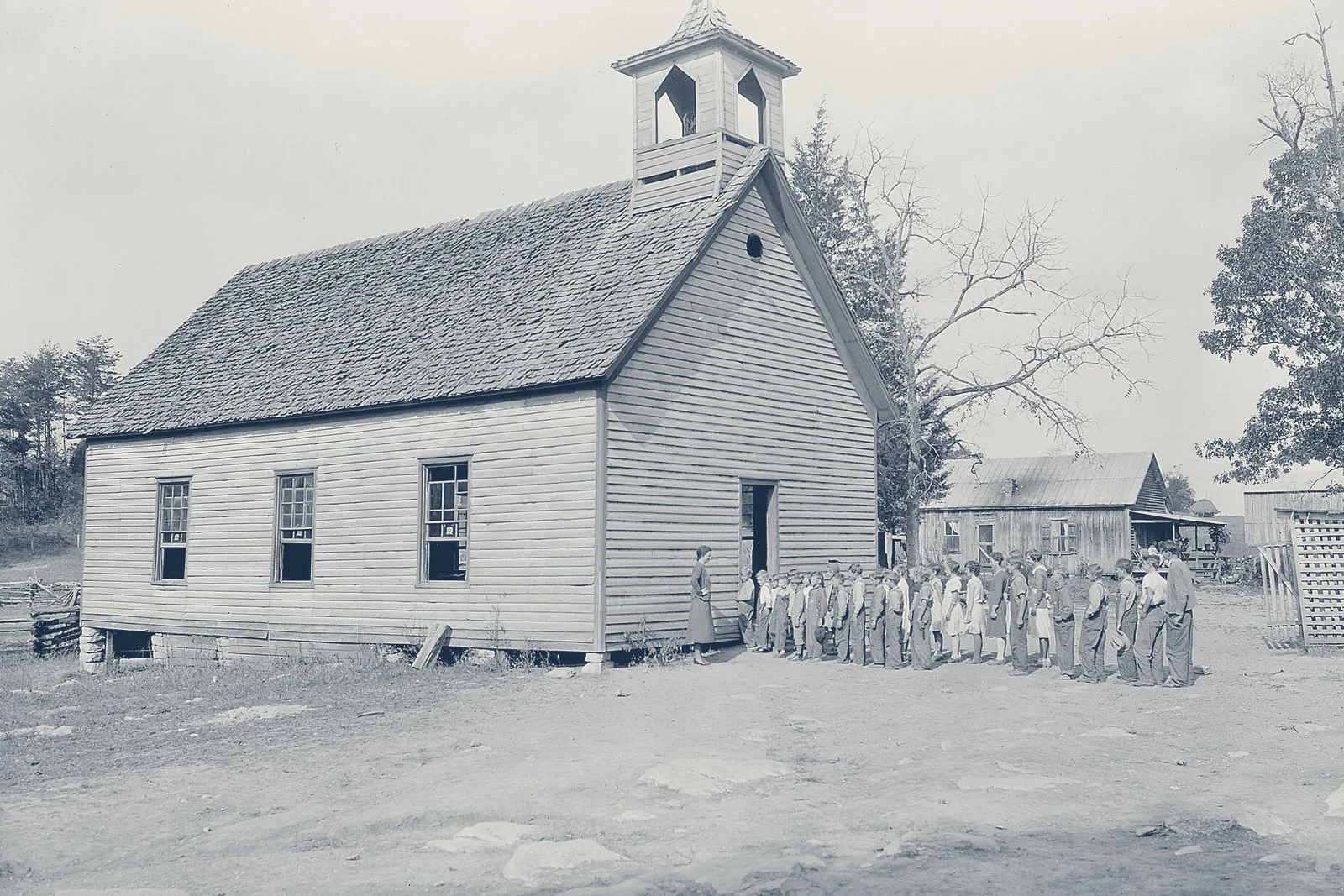
Featured image: Lewis Hine, “Exterior view of Oakdale School near Loyston, Tennessee,” Oct. 23, 1933. U.S. National Archives (NARA 532647), public domain, via Wikimedia Commons; cropped and duotoned by Check the Claim.
Spotted an error? Tell us.