No. Thomas Jefferson wrote that Virginia’s religious freedom law covered Jews, Muslims, Hindus and nonbelievers, and the Constitution bans religious tests for federal office. Some early states did punish blasphemy against the Christian God, so that part is real. Still, the claim that the founders meant religious freedom for Christians only gets our verdict: True fact, false conclusion.
- Early blasphemy laws in America were real, and they put people in jail.
- When Virginia lawmakers were asked to write “Jesus Christ” into their religious freedom law, they voted it down.
- In 1952, the Supreme Court said it isn’t the government’s job to shield a religion from attack.
What did Calvin Robinson say about blasphemy laws?
Calvin Robinson is a British commentator and a former presenter on the UK channel GB News (ITV News). He’s now a priest in the English Catholic Church in North America, a church in the Anglican tradition, founded in 2024. He serves a congregation in Grand Rapids, Michigan (The Living Church). In mid-November he was also among the speakers at a “Christ Is King” conference near Dallas.
- Nov. 23, 2026: Robinson appeared on American Family Radio’s “Jenna Ellis in the Morning.” That night he spoke on a show called “War Room Live,” according to Right Wing Watch. (That’s a project of the progressive group People For the American Way.)
- Nov. 24: Right Wing Watch posted a clip (video).
In it, Robinson says: “It should be illegal to criticize the Christian God.” If a Christian country has blasphemy laws, “it should be Christian blasphemy laws.”
Freedom of religion, he says, “doesn’t mean you get to come to a Christian land and set up a … temple, a synagogue, a mosque.” To “the founding fathers,” he adds, religion meant “the virtue of following the one true living God.” And it “was assumed that anyone who had religion was a Christian of some sort.”
Then he turns to government: “This is a Christian land. It should be ruled and governed by Christian people.”
That’s a claim about American history. So we checked the record.
What’s the case for Christian blasphemy laws in America?
Robinson’s side can point to real history.
- Early states had blasphemy laws. Massachusetts passed one in 1782 (Law Library of Congress). In 1811, New York’s chief justice, James Kent, upheld a blasphemy conviction, writing that “we are a christian people” (People v. Ruggles).
- Some states favored Christians in law. Delaware’s 1776 declaration of rights promised equal rights to “all Persons professing the Christian Religion” (text).
- He isn’t calling for forced conversion. “We’re not forcing people to take on board ours,” Robinson says.
Those facts check out. But do they show what the founders’ religious freedom meant?
Did freedom of religion only apply to Christians?
In fact, the founders wrote down whom they meant. Our post on whether Christianity is the only American religion goes deeper. Here, three pieces of the record answer Robinson directly.
The “Jesus Christ” vote. In 1786, Virginia passed Thomas Jefferson’s law for religious freedom. During debate, a lawmaker moved to add “Jesus Christ” to it. The insertion “was rejected by a great majority,” Jefferson recalled. The vote showed they meant to protect “the Jew and the Gentile, the Christian and Mahometan, the Hindoo, and Infidel of every denomination” (Jefferson’s autobiography). “Mahometan” is an old word for Muslim.
Natural rights for all. Robinson describes religious freedom as something a Christian land grants or withholds. In 1790, however, George Washington told a Jewish congregation in Newport, Rhode Island, that America had moved past that:
“It is now no more that toleration is spoken of, as if it was by the indulgence of one class of people, that another enjoyed the exercise of their inherent natural rights” (Founders Online).
No religious test. Robinson says the country should be “ruled and governed by Christian people.” The Constitution says “no religious Test shall ever be required as a Qualification to any Office or public Trust under the United States” (National Archives).
Didn’t the founders define religion as duty to God?
Yes, but: Robinson’s definition of religion isn’t far from Virginia’s. Its 1776 Declaration of Rights called religion “the duty which we owe to our Creator.” James Madison quoted it in 1785, during his fight against a Virginia tax to support Christian teachers. Then he drew the conclusion:
“The Religion then of every man must be left to the conviction and conscience of every man; and it is the right of every man to exercise it as these may dictate.”
James Madison, Memorial and Remonstrance, 1785
Christians also led that fight. John Leland, a Baptist preacher in Virginia, wrote in 1790: “The liberty I contend for, is more than toleration.” All should be “equally free, Jews, Turks, Pagans and Christians” (The Virginia Chronicle). Here, “Turks” means Muslims (Merriam-Webster).
So the founders who won the argument meant every faith, and none.
Was there “no persecution” between Christians?
Robinson says early America had Catholics in Maryland, Anglicans in Virginia and “Baptists in Texas,” with “no persecution of them by each other.” The record shows otherwise.
Some of this record comes from colonial laws, which aren’t the founding. Still, Robinson’s own examples reach back that far.
- Virginia jailed Baptists. In 1774, a young Madison complained of “5 or 6 well meaning men in close Goal [jail] for publishing their religious Sentiments.” The editors of his papers say they were most likely Baptist preachers in nearby Culpeper County (Founders Online).
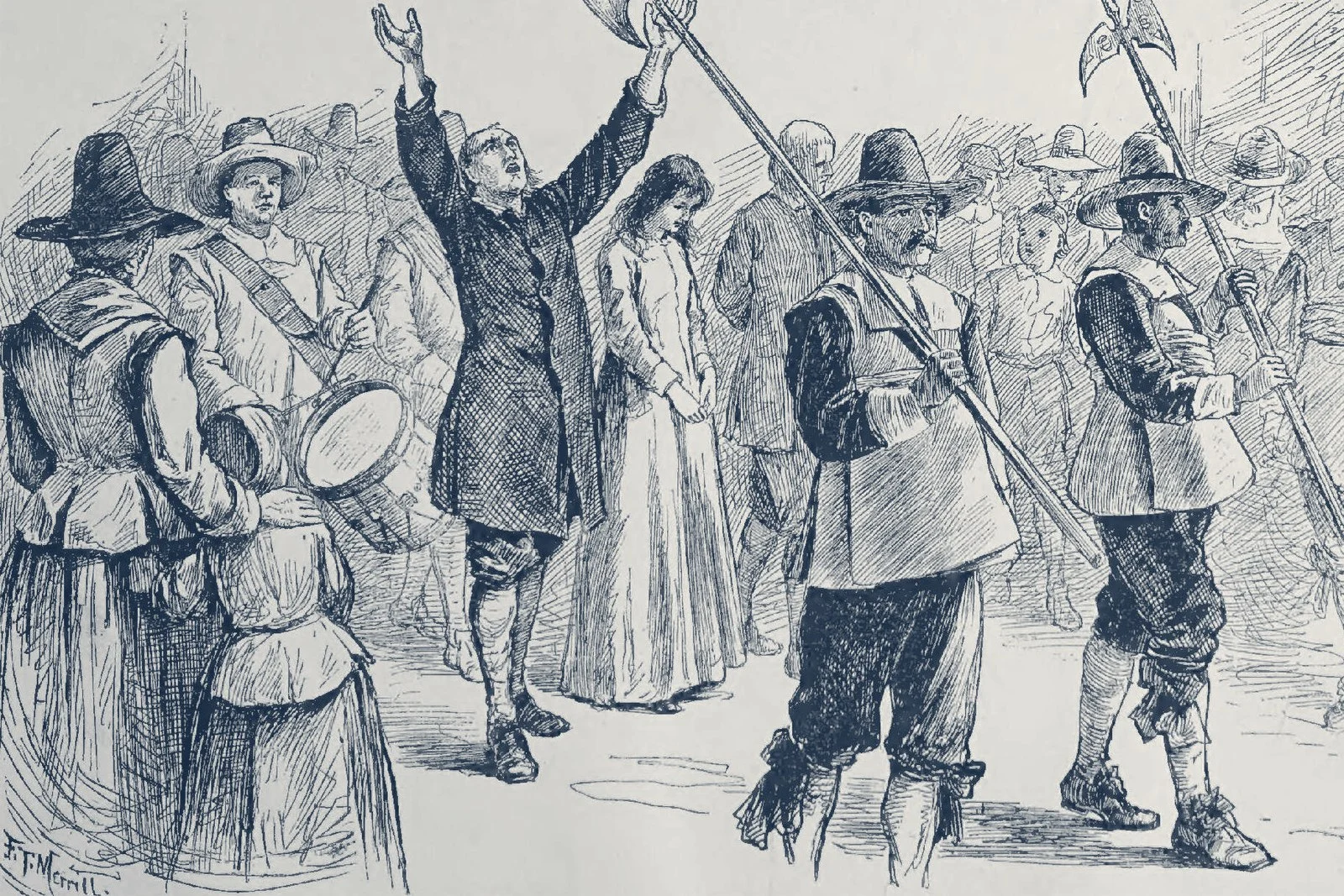
- Massachusetts hanged a Quaker. The Puritan colony “banned Quakers, Baptists, Catholics and Religious Dissenters.” Mary Dyer, a Quaker, “was hanged on June 1, 1660” (Massachusetts Secretary of the Commonwealth).
- Catholics were shut out. North Carolina’s 1776 constitution barred anyone who denied “the truth of the Protestant religion” from public office (text).
- Texas wasn’t in the country. Under Mexico’s 1824 constitution, the nation’s religion was “Roman Catholic and Apostolic,” and it “prohibits the exercise of any other” (Tarlton Law Library). Texas didn’t become a state until 1845 (Texas State Historical Association).
Maryland’s famous 1649 Toleration Act shows the trade-off. It protected Christians. Yet anyone who denied the Trinity “shalbe punished with death” (Avalon Project). So Christian blasphemy laws and Christian-only freedom came as a package.
Who pays the cost of blasphemy laws?
The people convicted under them did.
First, in New York, a man named Ruggles got three months in jail and a $500 fine for insulting Jesus (New York courts history). Judge Kent also wrote that the law didn’t have to treat insults to “the religion of Mahomet” the same way. In other words, only one faith got the law’s protection.
Then in 1838, Massachusetts’s top court upheld the conviction of Abner Kneeland, an editor who denied believing in God. He served 60 days in jail (Free Speech Center).
Robinson’s version would also add the Jewish, Muslim and Hindu families who couldn’t build “a temple, a synagogue, a mosque.”
The Supreme Court turned against such laws in 1952. New York had banned an Italian film as “sacrilegious.” The Court struck the ban down. “It is not the business of government in our nation to suppress real or imagined attacks upon a particular religious doctrine,” Justice Tom Clark wrote (Joseph Burstyn, Inc. v. Wilson). In plain words, shielding a religion from attack isn’t the government’s job.
In 2010, a federal judge also struck down a Pennsylvania rule against “blasphemy” in company names (ACLU of Pennsylvania).
Even Robinson’s home country moved the same way. England and Wales abolished their blasphemy offenses in 2008 (legislation.gov.uk).
Why it matters
The belief that being truly American means being a certain kind of Christian, with laws to match, sits at the core of Christian nationalism. A blasphemy law is that belief with a jail cell attached. It decides whose God the law protects, and whose neighbors can’t build a house of worship.
Many Christians reject that. For example, Baptists like Leland had seen Virginia jail their own preachers, and they fought for every faith’s freedom. See also our check on separation of church and state and whether American law is based on the Bible.
In his words
When a Samaritan village turned Jesus away, two of his disciples asked to punish it. (Elias is the prophet Elijah.)
“And they did not receive him, because his face was as though he would go to Jerusalem. And when his disciples James and John saw this, they said, Lord, wilt thou that we command fire to come down from heaven, and consume them, even as Elias did? But he turned, and rebuked them, and said, Ye know not what manner of spirit ye are of. For the Son of man is not come to destroy men’s lives, but to save them.” (Luke 9:53–56, KJV)
Supporters of blasphemy laws can point to the law of Moses: “he that blasphemeth the name of the LORD, he shall surely be put to death” (Leviticus 24:16, KJV). Christians read how those laws apply today in different ways.
Go deeper: Calls to bring back biblical penalties have a paper trail. In 1973, R. J. Rushdoony, the founder of a movement called Christian Reconstruction, listed blasphemy among the offenses he said Scripture punishes with death (our profile of Rushdoony).
What’s next?
As of 2023, five states still had laws that mention blasphemy, the Law Library of Congress noted. Massachusetts’s still threatens up to a year in jail for “cursing or contumeliously reproaching Jesus Christ” (Mass. General Laws). (“Contumeliously” means with scorn.)
In July 2025, the Massachusetts Senate voted 40–0 for a bill that would repeal it, along with other outdated laws. The bill has waited in the House since that September (S.2564). Watch whether it moves, and whether anyone in American politics takes up Robinson’s call to write those laws back into force.
Sources
Primary documents
- Thomas Jefferson, Autobiography (1821), The Founders’ Constitution, vol. 5, Amendment I (Religion), doc. 45, University of Chicago Press. https://press-pubs.uchicago.edu/founders/documents/amendI_religions45.html
- George Washington to the Hebrew Congregation in Newport, Rhode Island, Aug. 18, 1790, Founders Online, National Archives. https://founders.archives.gov/documents/Washington/05-06-02-0135
- James Madison to William Bradford, Jan. 24, 1774, Founders Online, National Archives. https://founders.archives.gov/documents/Madison/01-01-02-0029
- James Madison, Memorial and Remonstrance against Religious Assessments, ca. June 20, 1785, Founders Online, National Archives. https://founders.archives.gov/documents/Madison/01-08-02-0163
- The Constitution of the United States: A Transcription, National Archives. https://www.archives.gov/founding-docs/constitution-transcript
- Maryland Toleration Act, Sept. 21, 1649, Avalon Project, Yale Law School. https://avalon.law.yale.edu/18th_century/maryland_toleration.asp
- Delaware Declaration of Rights, Sept. 11, 1776, The Founders’ Constitution, doc. 26. https://press-pubs.uchicago.edu/founders/documents/amendI_religions26.html
- North Carolina Constitution of 1776, arts. 19, 31–32, 34, The Founders’ Constitution, doc. 29. https://press-pubs.uchicago.edu/founders/documents/amendI_religions29.html
- Federal Constitution of the United Mexican States (1824), Tarlton Law Library, University of Texas. https://tarlton.law.utexas.edu/constitutions/federal-mexican-1824-en/preamble-title-1
- John Leland, The Virginia Chronicle (1790), in The Writings of the Late Elder John Leland (1845), Internet Archive. https://archive.org/details/writingsoflateel00lela
- People v. Ruggles, 8 Johns. 290 (N.Y. 1811), The Founders’ Constitution, doc. 62. https://press-pubs.uchicago.edu/founders/documents/amendI_religions62.html
- Joseph Burstyn, Inc. v. Wilson, 343 U.S. 495 (1952), U.S. Reports, govinfo.gov. https://www.govinfo.gov/content/pkg/USREPORTS-343/pdf/USREPORTS-343-495.pdf
- Massachusetts General Laws, ch. 272, § 36 (Blasphemy). https://malegislature.gov/Laws/GeneralLaws/PartIV/TitleI/Chapter272/Section36
- Massachusetts Senate Bill S.2564 (2025–2026), An Act amending certain archaic laws (sec. 13 repeals ch. 272, § 36), bill history. https://malegislature.gov/Bills/194/S2564
- Criminal Justice and Immigration Act 2008, s. 79, legislation.gov.uk. https://www.legislation.gov.uk/ukpga/2008/4/section/79
Context and history
- Ryan Gale, “A History of Blasphemy Laws in the United States,” In Custodia Legis, Law Library of Congress, Dec. 19, 2023. https://blogs.loc.gov/law/2023/12/a-history-of-blasphemy-laws-in-the-united-states/
- “Virginia Statute for Establishing Religious Freedom (1786),” Encyclopedia Virginia, Virginia Humanities. https://encyclopediavirginia.org/entries/virginia-statute-for-establishing-religious-freedom-1786/
- “People v. Ruggles, 1811,” Historical Society of the New York Courts. https://history.nycourts.gov/case/people-v-ruggles/
- John R. Vile, “Commonwealth v. Kneeland (Mass.),” Free Speech Center, Middle Tennessee State University. https://firstamendment.mtsu.edu/article/commonwealth-v-kneeland-mass/
- “A Tale of Two Colonies,” Commonwealth Museum, Massachusetts Secretary of the Commonwealth. https://www.sec.state.ma.us/divisions/commonwealth-museum/exhibits/online/two-colonies/a-tale-of-two-colonies_15.htm
- “Annexation,” Handbook of Texas, Texas State Historical Association. https://www.tshaonline.org/handbook/entries/annexation
- ACLU of Pennsylvania, Kalman v. Cortes case page. https://www.aclupa.org/cases/kalman-v-cortes/
- “Calvin Robinson joins sixth denomination,” The Living Church, Feb. 10, 2026. https://livingchurch.org/news/calvin-robinson-joins-sixth-denomination/
- “Third GB News presenter suspended after channel boss condemns Laurence Fox remarks,” ITV News, Sept. 29, 2023. https://itv.com/news/2023-09-29/gb-news-boss-appalled-by-laurence-fox-comments-about-female-journalist
- “Our mission,” People For the American Way. https://www.peoplefor.org/mission-overview
- “Turk,” Merriam-Webster Dictionary. https://www.merriam-webster.com/dictionary/Turk
The claim, in its proponents’ words
- Right Wing Watch, “Calvin Robinson Says ‘It Should Be Illegal To Criticize The Christian God’” (video), Nov. 24, 2026. https://www.youtube.com/watch?v=nnefz9g4HYE
- Peter Montgomery, Right Wing Watch, Nov. 24, 2026. https://www.peoplefor.org/rightwingwatch/american-family-radios-jenna-ellis-promotes-antisemitic-christian-nationalist-calvin
Scripture
Luke 9:53–56; Leviticus 24:16 (KJV), Bible Gateway.
Spotted an error? Tell us.
Featured image: “Robinson, Stevenson, and Mary Dyer going to Execution,” engraving signed F. T. Merrill, in Samuel Adams Drake, A Book of New England Legends and Folk Lore (Roberts Brothers, 1884), public domain, via Wikimedia Commons; cropped and duotoned by Check the Claim.