No. Presidents have issued Thanksgiving proclamations since George Washington in 1789, and some early proclamations used plainly Christian words. That part is real. Our verdict on the claim that they prove America was founded as a Christian nation: True fact, false conclusion.
- The founders split over them. Thomas Jefferson refused to issue any as president, and James Madison later warned that they feed the idea of a national religion.
- Washington’s 1789 proclamation thanks “Almighty God.” It never mentions Jesus.
- The yearly November holiday came later. It took hold after Abraham Lincoln’s 1863 proclamation, and Congress set the date by law in 1941.
Why do Thanksgiving proclamations come up every November?
This Thursday is Thanksgiving, and the president will likely sign a proclamation for it. Last year’s quoted Washington and Lincoln. It also encouraged Americans “to offer a prayer of thanks to God for our many blessings” (govinfo.gov).
Each November, the old proclamations come back as evidence. They show a Christian nation, the argument goes, because the founders kept calling the country to pray.
What’s the case that Thanksgiving proclamations show a Christian nation?
Writers who make this case point to three things.
- The holiday itself. “That holiday is an annual reminder of our nation’s Christian roots, our godly heritage,” Jerry Newcombe of the Providence Forum wrote on Nov. 23, 2025 (Townhall).
- Explicitly Christian words. In 1777, the Continental Congress (which ran the war for independence) asked God to forgive the nation’s sins “through the merits of Jesus Christ” (Library of Congress). In 1798, President John Adams asked for pardon “through the Redeemer of the World” (Founders Online).
- An answer to the “secular founding.” Focus on the Family’s Daily Citizen put it this way in 2019: “the history of Thanksgiving Day shows precisely the opposite” (Daily Citizen).
Those quotations check out. The real question is what they prove. Our check of whether America was founded as a Christian nation covers the wider record.
What does Washington’s 1789 Thanksgiving proclamation say?
The first proclamation under the Constitution began in Congress. On Sept. 25, 1789, Rep. Elias Boudinot of New Jersey moved to ask the president for a day of thanks.
Two members objected on the spot, according to the Papers of George Washington at the University of Virginia:
- Aedanus Burke “did not like this mimicking of European customs, where they made a mere mockery of thanksgivings.”
- Thomas Tudor Tucker said “it is a religious matter, and, as such, is proscribed to us.” He added, “If a day of thanksgiving must take place, let it be done by the authority of the several States.”
In other words, the argument over federal religious proclamations is as old as the first one. Congress approved the request anyway, on Sept. 28 (National Archives).
Washington’s proclamation, dated Oct. 3, 1789, opens: “it is the duty of all nations to acknowledge the providence of Almighty God” (text). It thanks God for “the civil and religious liberty with which we are blessed.” It’s a sincere, devout document. But it never names Jesus.
That matters, because Washington’s faith often gets embellished. See his prayer at Valley Forge and Parson Weems and the pious Washington.
Why did Jefferson refuse to issue Thanksgiving proclamations?
Jefferson issued none in eight years as president. In 1808, when a minister named Samuel Miller asked for a day of fasting and prayer, he said no.
He considered the federal government “interdicted by the constitution from intermedling with religious institutions” (Founders Online). In plain words, the Constitution bars the federal government from meddling in religion.
He pointed to the First Amendment’s religion clauses, including the Establishment Clause (its ban on an official religion), and to the powers left to the states. A “recommendation,” he added, still carries pressure.
His conclusion: “civil powers alone have been given to the President.”
Yes, but: in 1779, as governor of Virginia, Jefferson did issue a day of thanksgiving, passing along a request from the Continental Congress. It mentioned “our gracious Redeemer” (Founders Online). His letter to Miller explains the difference. What “might be a right in a state government,” he wrote, became “a violation of that right when assumed by another.” That is, the national government.
He made the same case in a draft of his 1802 “wall of separation” letter to the Baptists of Danbury, Connecticut. He cut it to avoid upsetting political friends in New England, where governors’ thanksgiving proclamations were “an antient habit” (his spelling; Library of Congress). See our page on separation of church and state.
What did Madison and Adams say about them later?
James Madison, the fourth president, issued four religious proclamations during and just after the War of 1812. His 1814 one notes that both houses of Congress had asked for it (text). Later, in private notes, he spelled out his doubts.
“Altho’ recommendations only, they imply a religious agency, making no part of the trust delegated to political rulers,” he wrote (Founders Online). In plain words, leading the public in worship was a job voters never gave their officials.
He went further. Such proclamations, he wrote, “seem to imply and certainly nourish the erronious idea of a national religion.” (The spelling is his.) He said he had worded his own to make clear that taking part was voluntary.
John Adams, who called national fast days in 1798 and 1799, later blamed one for his defeat. “The National Fast, reccommended by me turned me out of Office,” he told Benjamin Rush in 1812 (Founders Online). There was “a general Suspicion,” he recalled, that the Presbyterian Church “aimed at an Establishment as a National Church.” That’s Adams’s own reading of his 1800 defeat, and elections turn on many things.
So the founders split, and two of the most important thought these proclamations didn’t fit the Constitution.
When did Thanksgiving become a yearly national holiday?
Mostly after the founders were gone. On Oct. 3, 1863, in the middle of the Civil War, Lincoln set apart “the last Thursday of November next.” It was a day of thanks “to our beneficent Father who dwelleth in the heavens” (American Presidency Project).
After that, each president set the date by proclamation, and the custom settled on the last Thursday of November (FDR Library). In 1939, Franklin Roosevelt moved it up a week to help holiday shopping. The backlash led Congress to fix the date. Roosevelt signed the fourth-Thursday law on Dec. 26, 1941 (National Archives).
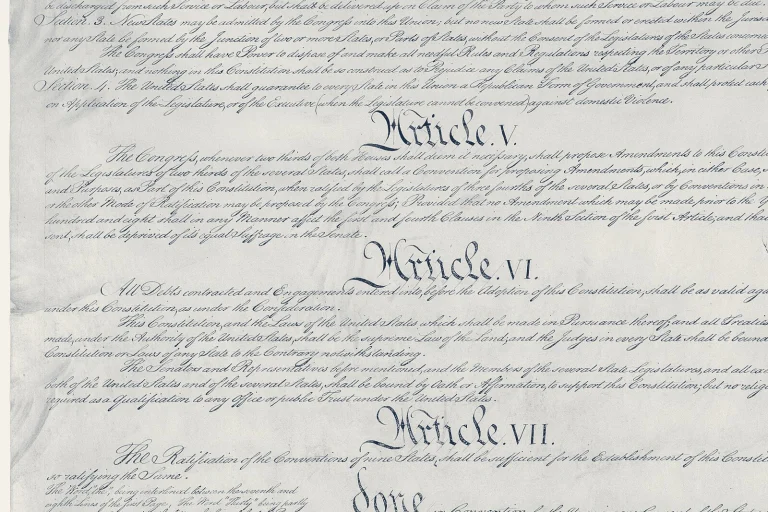
So the national holiday is a civic tradition built over time. It’s much like the 1950s mottos traced on our page about “In God We Trust” and “under God”. The Constitution itself never mentions God, apart from dating itself “in the Year of our Lord” (National Archives). We go deeper in Is the Constitution a Christian document?
Why do Thanksgiving proclamations matter?
Using a government prayer custom to prove a Christian nation is a building block of Christian nationalism. That’s the belief that being truly American means being a certain kind of Christian, and that government should act on it. If the proclamations prove the nation is Christian, then officials can decide whose prayers count.
Madison saw where that leads. In the 1780s, he fought a Virginia tax to support Christian teachers.
“Who does not see that the same authority which can establish Christianity, in exclusion of all other Religions, may establish with the same ease any particular sect of Christians, in exclusion of all other Sects?”
James Madison, Memorial and Remonstrance, 1785
Who pays the cost: In 1844, South Carolina Gov. James H. Hammond issued a Thanksgiving proclamation. It assumed “citizens of all denominations” would pray to “Jesus Christ, the Redeemer of the world,” historian Jonathan Sarna of Brandeis University writes (Sarna).
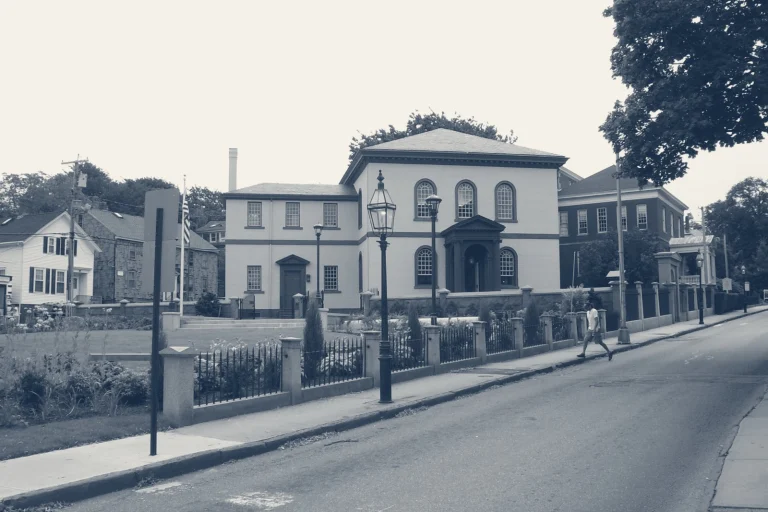
Charleston’s Jewish community protested. “We do not sue for toleration, but we demand our rights,” said their written protest, signed by 110 members of the community.
Hammond refused to apologize. He had “always thought it a settled matter that I lived in a Christian land!” he wrote. Charleston’s Jews kept their synagogues closed that Thanksgiving Day.
The proclamation, Sarna writes, left Jewish citizens to wonder “whether, in the governor’s eyes, they remained full citizens or not.”
In his words
“And one of them, when he saw that he was healed, turned back, and with a loud voice glorified God, And fell down on his face at his feet, giving him thanks: and he was a Samaritan. And Jesus answering said, Were there not ten cleansed? but where are the nine? There are not found that returned to give glory to God, save this stranger.” (Luke 17:15–18, KJV)
Christians who favor public prayer also cite Paul, who urged that “giving of thanks, be made for all men; For kings, and for all that are in authority” (1 Timothy 2:1–2, KJV). That asks believers to pray for leaders. Christians differ on whether leaders should call the prayers.
What to watch
Watch for this year’s proclamation. See whether it stays general, as Washington’s did, or names one faith.
Giving thanks is a tradition Americans of many faiths share. The proclamations show how old that habit is. They also show the founders arguing, from the very first one, over whether a national government should lead it. That argument is the founders’ own answer to the claim.
Sources
Primary documents
- George Washington, Thanksgiving Proclamation, Oct. 3, 1789 (Richardson text), The Founders’ Constitution, vol. 5, Amendment I (Religion), doc. 54, University of Chicago Press. https://press-pubs.uchicago.edu/founders/documents/amendI_religions54.html
- Continental Congress, Thanksgiving proclamation, Nov. 1, 1777, broadside (Boston printing), Library of Congress, Printed Ephemera Collection. https://tile.loc.gov/storage-services/service/rbc/rbpe/rbpe04/rbpe040/04001400/04001400.pdf
- John Adams, Proclamation Proclaiming a Fast-Day, March 23, 1798, Founders Online, National Archives. https://founders.archives.gov/documents/Adams/99-02-02-2386
- John Adams, Fast Day Proclamation, March 6, 1799, Founders Online, National Archives. https://founders.archives.gov/documents/Adams/99-02-02-3372
- John Adams to Benjamin Rush, June 12, 1812, Founders Online, National Archives. https://founders.archives.gov/documents/Adams/99-02-02-5807
- Thomas Jefferson, Proclamation Appointing a Day of Thanksgiving and Prayer, Nov. 11, 1779, Founders Online, National Archives. https://founders.archives.gov/documents/Jefferson/01-03-02-0187
- Thomas Jefferson to Samuel Miller, Jan. 23, 1808, Founders Online, National Archives. https://founders.archives.gov/documents/Jefferson/99-01-02-7257
- James Madison, Detached Memoranda, ca. 1820 (Founders Online date), Founders Online, National Archives. https://founders.archives.gov/documents/Madison/04-01-02-0549
- James Madison, Memorial and Remonstrance against Religious Assessments, ca. June 20, 1785, Founders Online, National Archives. https://founders.archives.gov/documents/Madison/01-08-02-0163
- Abraham Lincoln, Proclamation 106, Thanksgiving Day, Oct. 3, 1863, The American Presidency Project. https://www.presidency.ucsb.edu/documents/proclamation-106-thanksgiving-day-1863
- Donald J. Trump, Proclamation 10994, Thanksgiving Day, 2025, Nov. 25, 2025, Daily Compilation of Presidential Documents (govinfo.gov). https://www.govinfo.gov/content/pkg/DCPD-202501147/html/DCPD-202501147.htm
- The Constitution of the United States: A Transcription, National Archives. https://www.archives.gov/founding-docs/constitution-transcript
Scholarship and archives
- “Thanksgiving Proclamation,” The Papers of George Washington, University of Virginia (quoting the Annals of Congress, 1:949–50). https://washingtonpapers.org/documents/thanksgiving-proclamation/
- James Hutson, “‘A Wall of Separation’: FBI Helps Restore Jefferson’s Obliterated Draft,” Library of Congress Information Bulletin, June 1998. https://www.loc.gov/loc/lcib/9806/danbury.html
- Center for Legislative Archives, “Congress Establishes Thanksgiving,” National Archives. https://www.archives.gov/legislative/features/thanksgiving
- FDR Presidential Library, “The Year of Two Thanksgivings,” Nov. 14, 2022. https://fdr.blogs.archives.gov/2022/11/14/the-year-of-two-thanksgivings/
- Jonathan D. Sarna, “Christians and Non-Christians in the Marketplace of American Religion,” in American Christianities, ed. Catherine A. Brekus and W. Clark Gilpin. https://www.brandeis.edu/hornstein/sarna/christianjewishrelations/christiansandnonchristians.pdf
The claim, in its proponents’ words
- Jerry Newcombe, “Our Nation’s First Thanksgiving Proclamation: NOT Namby-Pamby,” Townhall, Nov. 23, 2025. https://townhall.com/columnists/jerrynewcombe/2025/11/23/our-nations-first-thanksgiving-proclamation-not-namby-pamby-n2666722
- Zachary Mettler, “Thanksgiving Day Reveals America’s Christian Roots,” Daily Citizen (Focus on the Family), Nov. 27, 2019. https://dailycitizen.focusonthefamily.com/thanksgiving-day-reveals-americas-christian-roots/
Scripture
Luke 17:15–18; 1 Timothy 2:1–2 (KJV), Bible Gateway.
Featured image: George Washington’s Oct. 3, 1789, Thanksgiving Day Proclamation, National Archives (NAID 299956), public domain, via Wikimedia Commons; cropped and duotoned by Check the Claim.
Spotted an error? Tell us.