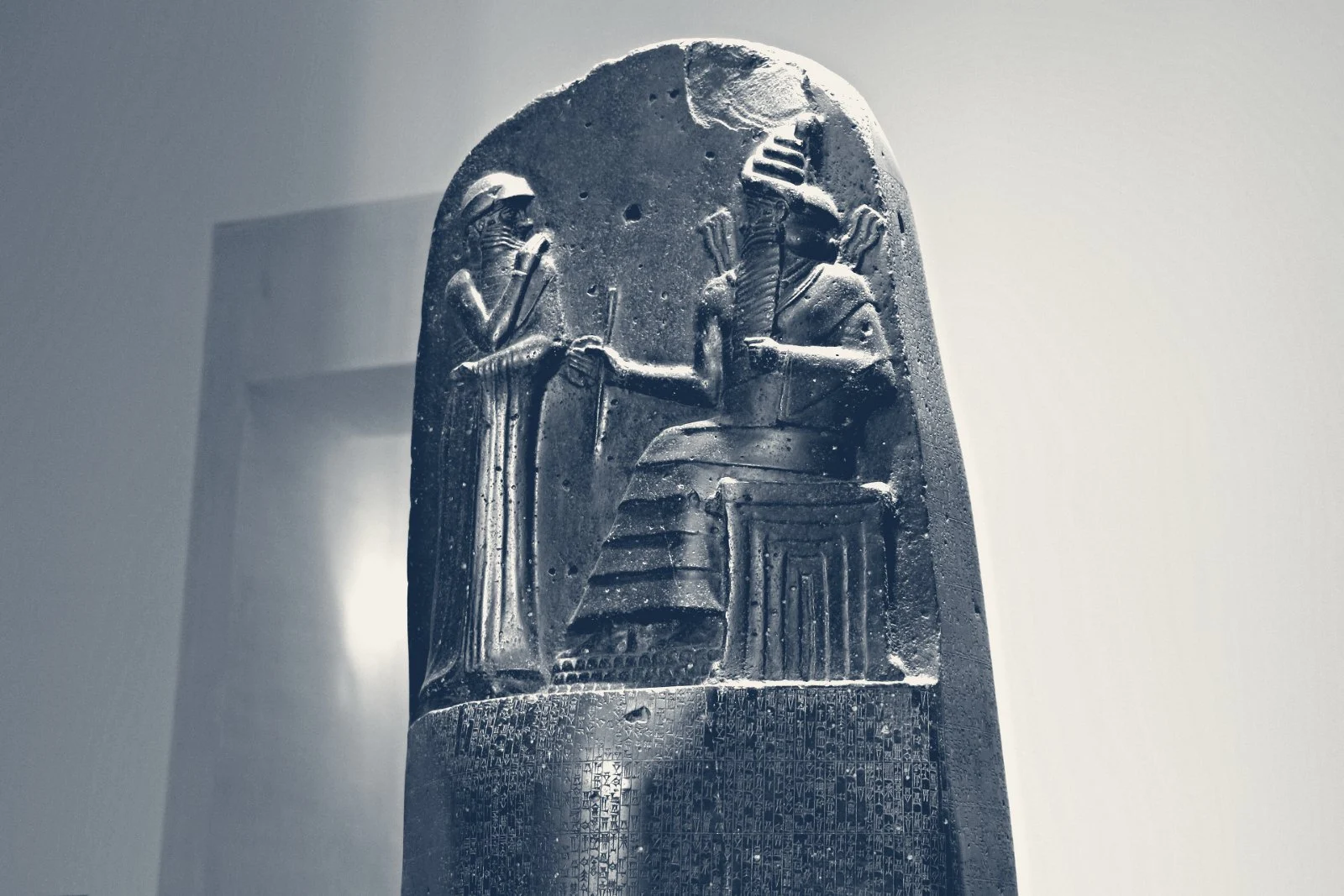
An ox gores someone to death. Was the owner warned the animal was dangerous? If so, he’s responsible. That rule appears in the Bible, in Exodus 21. It also appears in the Code of Hammurabi, carved in stone in ancient Babylon long before the time the Bible’s story places Moses.
People sometimes say American law comes from the Bible, as if biblical law were where legal reasoning began. Comparing the Code of Hammurabi and the Bible shows a bigger and older world of law. It also shows real differences, and a scholarly argument that’s still going.
Is “before Moses” a date?
No. Historians don’t have a firm date for Moses, and this post doesn’t assign one. “Before Moses” is shorthand for a comparison: the Mesopotamian law collections we can date are older than the periods in which the biblical story is traditionally set. Scholar Jonathan Burnside’s chronology keeps those apart. (Burnside, p. xxiii)
The Louvre in Paris, which holds Hammurabi’s stone monument, dates it to about 1750 BCE. (Louvre) And Hammurabi wasn’t first. Burnside dates the laws of Ur-Nammu to about 2100 BCE, Lipit-Ishtar to about 1930 and Eshnunna to about 1770. (Burnside, p. xxiii and p. 3) Oxford’s Bodleian Library law guide also lists Ur-Nammu’s collection at about 2100 BCE, with rules on homicide, assault, false accusations, marriage and property. (Bodleian Libraries) Those are the dates of surviving collections. People were settling disputes long before anyone wrote the rules down.
Hammurabi’s law was religious too
It would be wrong to read this as secular reason beating religion. The carving at the top of Hammurabi’s monument shows the king standing before Shamash, the god associated with justice, and the inscription’s opening and closing sections claim divine backing for the king’s mission. (Louvre; inscription, Avalon Project)
“Code” is also a bit misleading. The Louvre describes it as a collection of judgments, not a complete legal code in the modern sense. (Louvre) A written rule tells us what the text says. It doesn’t tell us how often judges actually used it.
The goring ox, side by side
Hammurabi (laws 250–252, modern translation): if an ox gores someone unexpectedly, there’s no claim. If the owner had already been told the ox was dangerous and did nothing, he pays, and the amount depends on the victim’s social status. (David P. Wright’s appendix, TheTorah.com)
Exodus 21:28–32 (KJV): “If an ox gore a man or a woman, that they die: then the ox shall be surely stoned … but the owner of the ox shall be quit.” But if the ox “were wont to push with his horn in time past, and it hath been testified to his owner,” then “the ox shall be stoned, and his owner also shall be put to death,” though a ransom could be paid instead. If the victim was enslaved, the owner “shall give unto their master thirty shekels of silver.” (Exodus 21, KJV)
Same problem, same key question (did the owner know?), different answers. Notice something else, too: in both, an enslaved victim’s loss is paid to someone else. Both texts sort people by legal status. Familiar reasoning about responsibility sits right next to an ancient hierarchy, and being old doesn’t make that hierarchy acceptable.
The comparison isn’t just between two famous texts, either. The laws of Eshnunna also cover dangerous oxen, with different payments for free and enslaved victims. (Kazen and Lipka, TheTorah.com, quoting Martha Roth’s translation) These were shared legal problems across a whole region.
The differences matter as much as the parallels
Injury laws show the contrast. Hammurabi’s laws 196–201 allow “eye for an eye” punishment among people of the higher-status class (the awīlum), but compensation for injuries to people of lower status, and payment tied to an enslaved person’s value. (Wright, Inventing God’s Law, pp. 39–40)
Exodus has eye-for-an-eye language too, but adds this: “if a man smite the eye of his servant, or the eye of his maid, that it perish; he shall let him go free for his eye’s sake.” (Exodus 21:26, KJV) Freedom instead of a payment is a meaningful difference. It isn’t the end of slavery, though; the surrounding laws still assume it.
So calling either text a copy of the other misses something. So does calling either one an early version of modern equality.
Did the Bible copy Hammurabi?
This is where scholars genuinely disagree, and both sides have a real case.
The case for borrowing: David P. Wright argues that the Bible’s “Covenant Code” (the laws in Exodus 20–23) deliberately reworked Hammurabi’s laws, based on patterns in their order, wording and changes. He dates its writing to 740–640 BCE. That date is his reconstruction from the texts. (Wright, Inventing God’s Law, pp. 3–4, 7–15)
The case for caution: Burnside warns that similarity alone doesn’t prove direct copying. Shared customs could explain a lot, and the route by which a Babylonian text would have reached biblical writers isn’t fully documented, though some literary influence during later editing is possible. (Burnside, pp. 6–7)
What’s secure is that biblical law belongs to an older and wider ancient legal world. How much was borrowed, and how, is still being argued.
Why this matters
For a believer, older parallels can fit the idea that people everywhere recognize moral obligations. For someone who sees morality as coming from human social life, the same parallels fit that view. A stone monument can’t settle that question.
What it can do is check a historical claim. The Ten Commandments and the laws around them weren’t the first written laws, so “law started with the Bible” doesn’t hold up.
The same care applies to the claim that American law is based on the Bible: two legal systems covering the same subject (injury, property, dangerous animals) doesn’t prove one came from the other.
We test that claim on our page Is American law based on the Bible? For what the Constitution itself names as its source of authority, see Is the Constitution a Christian document?, and for the current push to post the commandments in classrooms, see Ten Commandments in schools, explained.
Sources
-
Musée du Louvre, “The Code of Hammurabi.” https://www.louvre.fr/en/the-code-of-hammurabi
-
Code of Hammurabi, prologue and epilogue (L. W. King translation), Avalon Project, Yale Law School. https://avalon.law.yale.edu/ancient/hamcode.asp
-
David P. Wright, “How Exodus Revises the Laws of Hammurabi,” TheTorah.com (appendix with laws 250–252 in modern translation). https://www.thetorah.com/article/how-exodus-revises-the-laws-of-hammurabi
-
David P. Wright, Inventing God’s Law (Oxford University Press), publisher preview, pp. 3–4, 7–15, 39–40. https://api.pageplace.de/preview/DT0400.9780199719525_A23608671/preview-9780199719525_A23608671.pdf
-
Jonathan Burnside (Oxford University Press), publisher preview, chronology p. xxiii, table 1 p. 3, pp. 6–7. https://api.pageplace.de/preview/DT0400.9780199826544_A23610150/preview-9780199826544_A23610150.pdf
-
Thomas Kazen and Hilary Lipka, TheTorah.com, footnote 12 (laws of Eshnunna 53–55, Martha Roth’s translation). https://www.thetorah.com/article/torah-law-wasnt-originally-authoritative
-
Bodleian Libraries, University of Oxford, law guide: Mesopotamia. https://libguides.bodleian.ox.ac.uk/law-menat/mesopotamia
-
Exodus 21:23–32, King James Version, Bible Gateway. https://www.biblegateway.com/passage/?search=Exodus+21%3A23-32&version=KJV
Photo: the Code of Hammurabi stele, Louvre Museum, by Fred Romero, CC BY 2.0, via Wikimedia Commons; cropped and duotoned by Check the Claim.
Spotted an error? Tell us.