Verdict: Misleading. Texas’s Ten Commandments Supreme Court filing calls the Commandments a foundation of our legal system. The Bible did shape some early American law. But “foundation” goes further than the record does.
- Only three of the ten match crimes in American law: murder, theft and lying under oath. Most of the rest are about worshiping God, and the First Amendment keeps government out of that.
- The Constitution never mentions God, the Bible or the Ten Commandments. Neither do James Madison’s notes from the 1787 convention where it was written.
- Laws against theft are older than the Ten Commandments. Babylon’s Code of Hammurabi punished it more than 3,700 years ago.
What happened in the Texas Ten Commandments Supreme Court case?
In 2025, Texas passed a law requiring a Ten Commandments poster in every public school classroom. Families of several faiths sued, saying the state was pushing one religion on their children. In April, a federal appeals court sided with Texas, 9 to 8. The families then asked the U.S. Supreme Court to take the case.
On Nov. 10, Texas gave the justices its answer: don’t. The state’s filing also made a surprising point. Texans just elected a new attorney general, and he “has publicly stated that he ‘will not defend’ the challenged law.” So, Texas told the Court, the justices might not hear a full defense of the law.
That’s the news. The filing also makes a claim about history, and that’s the part we checked.
Why does Texas think the law is safe?
In 1980, in a case called Stone v. Graham, the Supreme Court struck down a nearly identical poster law from Kentucky. Texas says that ruling is out of date. It relied on a legal test the Court said in 2022 it had “long ago abandoned”, and a group of law professors filed a brief agreeing the Court has moved past that test.
Whether the 1980 ruling still stands is a real legal question, and only the Supreme Court can settle it. We don’t rate it here.
Are the Ten Commandments a foundation of American law?
Texas’s filing opens by saying the Commandments “have historical significance as one of the foundations of our legal system.” That idea has real support, so here is the best case for it first.
The case for it: Some early American law drew on the Bible openly. In 1641, Massachusetts told its judges to decide cases its own laws didn’t cover “by the word of God” (Body of Liberties). John Adams, a founder and later president, tied “Thou shalt not steal” to protecting property (The Founders’ Constitution).
What the record shows: “Foundation” claims a lot more than influence.
- Only three match our crimes. Murder, theft and false witness (lying under oath) are crimes. In the 1980 case, the Court noted that the first part of the Commandments “concerns the religious duties of believers”: worshiping one God, avoiding idols, not misusing God’s name and keeping the Sabbath. American law doesn’t require any of those. And “Thou shalt not covet” is about a feeling, which no law punishes.
- The Constitution is silent. Its text never mentions God, the Bible or the Commandments. We searched every day of Madison’s notes of the 1787 debates for “commandment,” “Decalogue,” “Moses” and “Bible.” None appear.
- Some of the rules are much older. Babylon’s Code of Hammurabi, from about 1750 BC (Louvre), punished theft and false accusations in court. Many societies banned these things. Sharing a rule doesn’t show where ours came from.
So the Bible influenced some early American law. That’s different from being its foundation. Go deeper: Is American law based on the Bible?
What did the founders say about religion and government?
Some of the clearest answers come from a fight in Virginia in 1785, a few years before the Constitution.
That year, Patrick Henry’s allies pushed a bill for a state tax to support “teachers of the Christian Religion.” James Madison, who would later draft the Bill of Rights, wrote a protest against it called the Memorial and Remonstrance. His core point:
“The Religion then of every man must be left to the conviction and conscience of every man; and it is the right of every man to exercise it as these may dictate.”
James Madison, Memorial and Remonstrance, 1785
The tax failed. Virginia passed Thomas Jefferson’s Act for Establishing Religious Freedom instead, signed in January 1786. It opens with a religious argument, “Almighty God hath created the mind free,” and then makes it law:
“[N]o man shall be compelled to frequent or support any religious worship, place, or ministry whatsoever … all men shall be free to profess, and by argument to maintain, their opinion in matters of religion.”
Thomas Jefferson, Act for Establishing Religious Freedom, 1786
These founders were not hostile to faith. They believed faith belongs to each person’s conscience, and that government has no business choosing it for anyone. A state rule that puts one faith’s text in front of every child runs straight into that idea. Go deeper: Is separation of church and state in the Constitution?
Do Americans know the Ten Commandments?
In 2019, the Pew Research Center asked nearly 11,000 American adults a simple quiz question: Which of these is NOT one of the Ten Commandments?
- Do not commit adultery
- Do not steal
- Keep the Sabbath holy
- Do unto others as you would have them do unto you
The answer is the last one, the golden rule. It isn’t in the Ten Commandments at all. It comes from Jesus, in the Sermon on the Mount (Matthew 7:12, KJV).
Only 58% got it right. Another 29% picked “Keep the Sabbath holy,” which is one of the Ten Commandments. The rest picked another wrong answer, said they weren’t sure, or skipped it (Pew’s full results). In other words, more than 4 in 10 Americans couldn’t pick out Jesus’s own teaching from the list of commandments.
People also value some commandments far more than others. In a 2018 Deseret News/YouGov poll, more than 90% of Americans called the bans on murder, stealing and lying important principles to live by. Only 49% said the same about keeping the Sabbath holy. For about half of Americans, then, at least one of the Ten Commandments doesn’t feel like an important rule to live by today.
That gap matters here. The commandments most Americans embrace are the ones already in our laws. The ones that are purely religious are the ones a classroom poster adds.
Who’s affected?
The families who sued told the courts in their own words. Cantor Seth Ettinger is raising his child in the Jewish faith. He called the state’s version “Christian-centric.” Dr. Arvind Chandrakantan, a Hindu father, said the posters tell his children “Christianity is the only acceptable religion in school.”
Christians are on both sides. One plaintiff, Mara Richards Bim, is an ordained pastor raising her child in the Baptist faith. Her church, she said, emphasizes “the Commands of Jesus: to love God and to love our neighbors just as we love ourselves.”
That echoes Jesus’s own summary of the law: “Thou shalt love thy neighbour as thyself” (Matthew 22:39, KJV).
What’s next?
- The families can reply to Texas. After that, the justices decide in private whether to take the case. No date is set yet (docket).
- Louisiana has a similar case waiting at the Court (Brumley v. Roake).
- January: Democrat Nathan Johnson becomes Texas attorney general. As a candidate he told CBS News Texas he won’t defend the law “because it’s unconstitutional.”
For the full story of the classroom fight, see our explainer: Ten Commandments in schools, explained.
So what is the poster for?
Supporters say the posters simply recognize history. Put that next to the record.
Look at what the poster adds
- The lessons everyone agrees on are already law. Murder, theft and lying under oath are crimes in every state. A poster doesn’t make them more illegal.
- What the poster adds is worship. Its required text (SB 10) tells every child to have no other gods, make no idols and keep the Sabbath. Only about half of Americans call that last one important, and nearly 3 in 10 didn’t recognize it as a commandment.
- It has nothing from Jesus. No golden rule. No “love thy neighbour.” Nothing from the Sermon on the Mount, where Jesus taught: “when thou prayest, thou shalt not be as the hypocrites are: for they love to pray standing in the synagogues and in the corners of the streets, that they may be seen of men” (Matthew 6:5, KJV).
- The sponsors say what they want. Sen. Phil King, the Texas law’s author, said in a June 2025 podcast interview that he wants every child to see “those statements of God, those rules of God” in “their classroom every single day of their public education” (as quoted in the families’ petition). Louisiana’s governor, days before signing his state’s version, told a crowd: “I can’t wait to be sued” (Red River Radio).
- Supporters are seeking a court test. Similar bills have spread from state to state. In 2025, The 74, an education news site, reported that the Arkansas and Texas mandates “follow the same Project Blitz template” (The 74). Project Blitz is a set of model bills from religious-right groups. And Texas asks the Supreme Court, if it takes the case, to overturn its 1980 ruling.
What this case is about
Christians are among the families suing Texas, including a Baptist pastor. So this is a fight among believers as much as between faiths. On one side are people who want the state to display one faith’s text in every classroom. On the other are people who want families to choose for themselves. Critics link the first view to Christian nationalism. Scholars define it as demands that government declare the nation Christian, promote Christian values and reject strict separation of church and state.
Texas law already forbids killing and stealing. What the poster adds is the state’s power to decide whose God hangs on every classroom wall. That is what this case is about.
Madison saw where that power leads, and asked the question in 1785:
“Who does not see that the same authority which can establish Christianity, in exclusion of all other Religions, may establish with the same ease any particular sect of Christians, in exclusion of all other Sects?”
James Madison, Memorial and Remonstrance, 1785
Go deeper: The Bible gives the Ten Commandments twice, and Jews, Catholics and most Protestants count and word them differently. Our claim page “Which Ten Commandments?” lays out the versions and what the Texas poster chose.
Related (added Nov. 14, 2026): Before Moses: what the Code of Hammurabi shows about biblical law
Related (added Nov. 23, 2026): “Repealing the Ten Commandments law would censor parts of American history”: Texas’s SB 115, checked
Sources
- Texas’s brief in opposition, Nathan v. Alamo Heights ISD, No. 26-257 (Nov. 10, 2026). https://www.supremecourt.gov/DocketPDF/26/26-257/432456/20261110160551879_26-257_Brief%20in%20Opposition.pdf
- Families’ petition for certiorari, No. 26-257. https://www.supremecourt.gov/DocketPDF/26/26-257/420045/20260825123322895_26-%20Corrected%20Petition.pdf
- Supreme Court docket, No. 26-257. https://www.supremecourt.gov/docket/docketfiles/html/public/26-257.html · No. 25-1360. https://www.supremecourt.gov/docket/docketfiles/html/public/25-1360.html
- Stone v. Graham, 449 U.S. 39 (1980). https://www.law.cornell.edu/supremecourt/text/449/39
- Kennedy v. Bremerton School District (2022). https://www.supremecourt.gov/opinions/21pdf/21-418_i425.pdf
- U.S. Constitution, National Archives. https://www.archives.gov/founding-docs/constitution-transcript
- Madison’s notes of the Federal Convention, Avalon Project. https://avalon.law.yale.edu/subject_menus/debcont.asp
- Massachusetts Body of Liberties (1641), Hanover College. https://history.hanover.edu/texts/masslib.html
- John Adams, Defence of the Constitutions (1787–88), in The Founders’ Constitution. https://press-pubs.uchicago.edu/founders/documents/v1ch16s15.html
- Code of Hammurabi, Avalon Project. https://avalon.law.yale.edu/ancient/hamcode.asp · Louvre. https://www.louvre.fr/en/the-code-of-hammurabi
- Pew Research Center, “What Americans Know About Religion” (2019). https://www.pewresearch.org/religion/2019/07/23/what-americans-know-about-religion/
- Deseret News, “Poll: Are the Ten Commandments still relevant today?” (2018). https://www.deseret.com/2018/3/28/20642391/poll-are-the-ten-commandments-still-relevant-today-americans-and-brits-differ-and-millennials-stand
- Texas S.B. 10 (89th Leg., enrolled), poster text. https://capitol.texas.gov/tlodocs/89R/billtext/html/SB00010F.htm
- Matthew 22:37–40 (KJV), Bible Gateway. https://www.biblegateway.com/passage/?search=Matthew%2022%3A37-40&version=KJV
- James Madison, Memorial and Remonstrance against Religious Assessments (ca. June 20, 1785), Founders Online. https://founders.archives.gov/documents/Madison/01-08-02-0163
- Act for Establishing Religious Freedom (passed 1785, signed Jan. 1786), Founders Online. https://founders.archives.gov/documents/Madison/01-08-02-0206
- Pew Research Center, Religious Knowledge survey topline (2019). https://www.pewresearch.org/wp-content/uploads/sites/20/2019/07/W44-Religious-Knowledge-TOPLINE-FOR-RELEASE-CHECK-COMPLETE.pdf
- Matthew 6:5–6 and 7:12 (KJV), Bible Gateway. https://www.biblegateway.com/passage/?search=Matthew%206%3A5-6&version=KJV · https://www.biblegateway.com/passage/?search=Matthew%207%3A12&version=KJV
- Red River Radio, “Louisiana governor ‘can’t wait to be sued’ on Ten Commandments law” (June 21, 2024). https://www.redriverradio.org/news/2024-06-21/louisiana-governor-cant-wait-to-be-sued-on-ten-commandments-law
- Mark Keierleber, The 74 (July 18, 2025). https://www.the74million.org/article/state-laws-requiring-ten-commandments-in-schools-are-the-product-of-a-far-right-bill-mill/
- CBS News Texas (April 2026). https://www.cbsnews.com/texas/news/democratic-candidates-for-texas-attorney-general-call-the-states-taxpayer-funded-school-choice-program-and-ten-commandments-law-unconstitutional/
Spotted an error? Tell us.
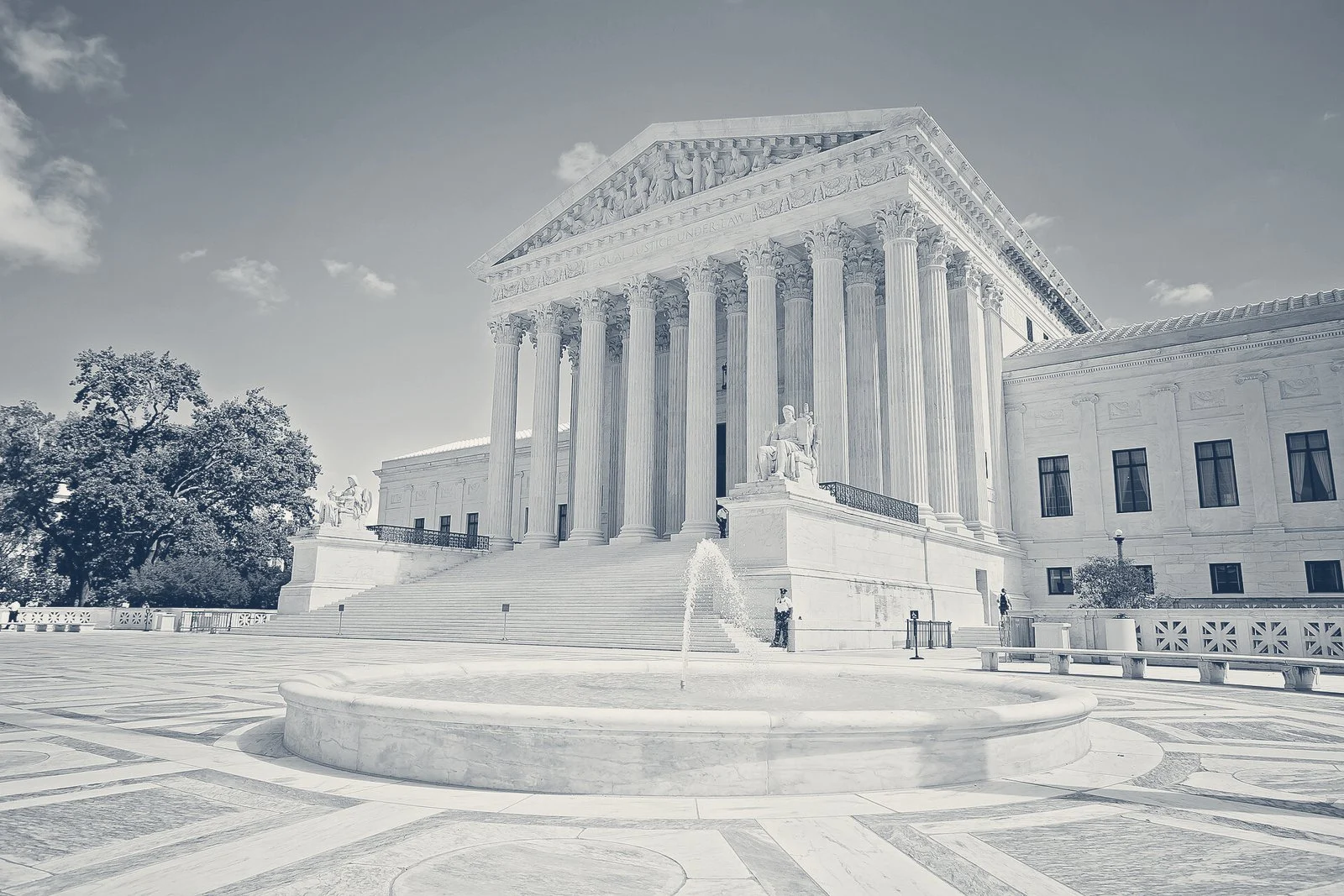
Image: “United States Supreme Court Building on a Clear Day” by Sunira Moses, CC BY-SA 3.0, via Wikimedia Commons; duotoned by Check the Claim (CC BY-SA 3.0).