
On April 21, 2026, President Trump stood at the Museum of the Bible in Washington and read a short passage aloud for “America Reads the Bible,” a weeklong public reading of the whole Bible. The event’s lead organizer, Bunni Pounds, chose his passage herself: 2 Chronicles 7, built around verse 14. (Word&Way/RNS)
If you grew up in church, you may know it by heart. In the King James Version:
If my people, which are called by my name, shall humble themselves, and pray, and seek my face, and turn from their wicked ways; then will I hear from heaven, and will forgive their sin, and will heal their land.
It shows up on church signs, prayer-breakfast programs and National Day of Prayer materials. It may be the most political verse in American Christianity. So it’s worth asking two plain questions. What does the verse say in its own setting? And how did it become a promise to the United States?
The fair case for quoting it
Most people who quote this verse mean something sincere and modest: a call for Christians to pray, repent and look at their own lives before blaming anyone else. Even careful critics accept that reading. Writing for The Gospel Coalition, a conservative evangelical outlet, pastor Steve Bateman argues that the verse isn’t a direct promise to America, but that it “certainly applies to the American church” as a pattern of repentance. (The Gospel Coalition)
That’s a reasonable use. The question is what happens when “my people” quietly turns into “Americans.”
What the verse says in context
The verse is God’s answer to King Solomon after Solomon dedicates the temple in Jerusalem (2 Chronicles 7:11–22). In that setting, “my people, which are called by my name” are the people of Israel. “Their land” is the land of Israel.
The promise also comes with a warning. A few verses later (7:19–22), the text says that if the people turn away, they’ll be uprooted from the land and the temple itself will become a byword among the nations. Chronicles ends with exactly that: the temple destroyed and the people carried off to Babylon (2 Chronicles 36).
So the verse is a conditional promise to one nation, tied to one land and one building. Reading it as a promise to the United States means treating America as a stand-in for ancient Israel. Many Christians make that move sincerely. It’s still an addition to the text; the verse itself never mentions any other nation.
How it became America’s verse
The national reading has a traceable history. Here are the milestones we could document:
- Civil War: Union chaplains and Northern preachers invoked it, according to religion reporter Brian Kaylor. (Word&Way/RNS)
- 1953: Dwight Eisenhower took his oath with George Washington’s Bible open to the verse, at Billy Graham’s suggestion (Kaylor).
- 1976–77: Bateman traces the popular “this verse is about America” reading to the nation’s bicentennial and to The Light and the Glory, a 1977 bestseller by Peter Marshall and David Manuel that told American history as a story of God’s covenant plan.
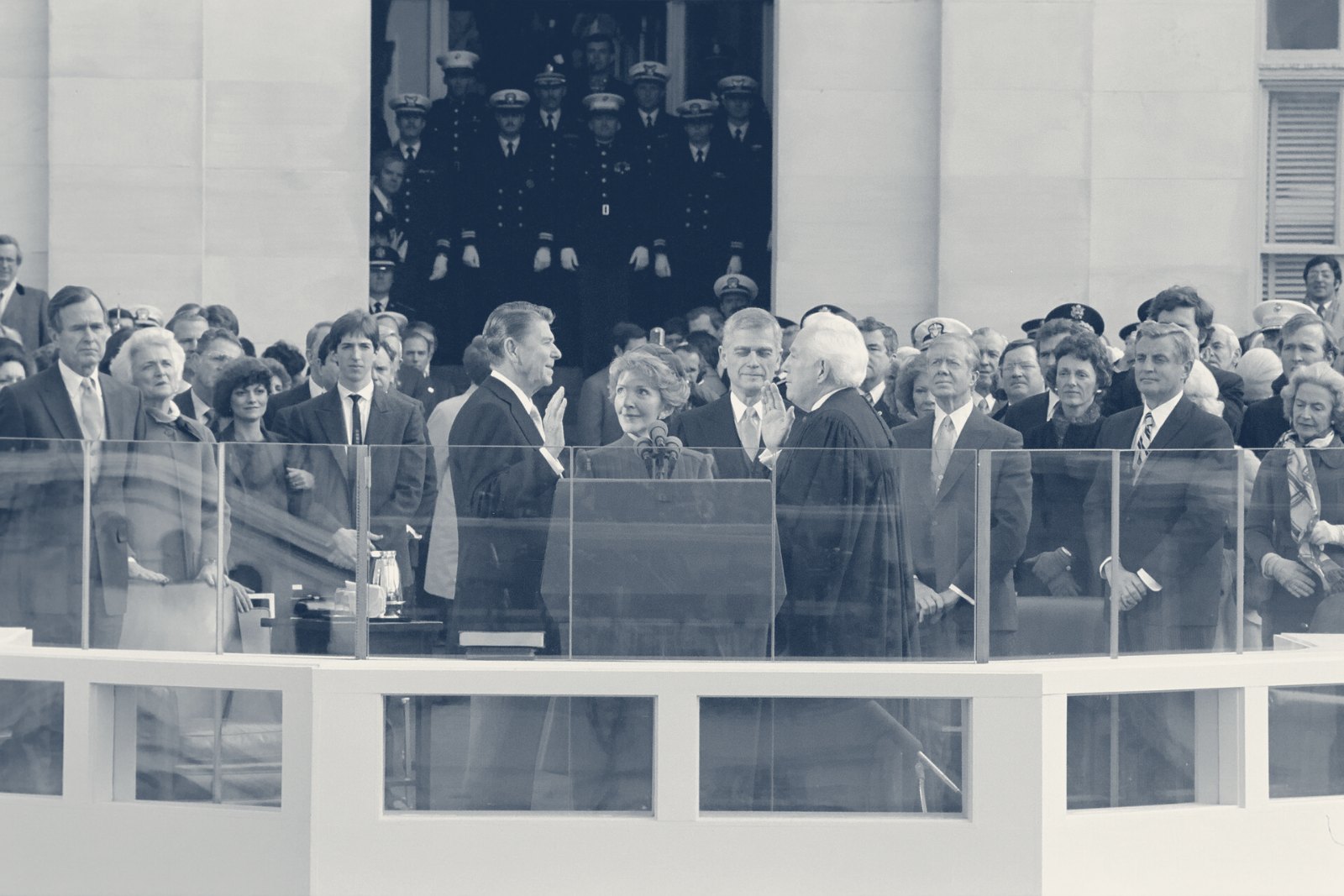
- 1981 and 1985: Ronald Reagan took both oaths of office on his mother’s Bible, opened to 2 Chronicles 7:14. (Museum of the Bible) His proclamation for the 1984 National Day of Prayer quoted it in full. (American Presidency Project)
- 2017: Mike Pence was sworn in as vice president on that same Reagan family Bible, opened to the same verse. (CBS News)
- 2023–24: It was the verse most often cited in the prayers opening Trump campaign rallies, according to Kaylor’s count.
- 2026: The president reads it aloud at the Museum of the Bible.
Notice the pattern. The verse moved from sermons to the inaugural platform in the 1950s, the same decade that added “under God” to the Pledge and made “In God We Trust” the national motto. We checked those dates, too.
Why this matters
On this site, Christian nationalism means fusing Christian and American identity and asking government to privilege that identity. This verse is one of the quietest places where that fusion happens. Nobody announces it. “My people” just slides from Israel, or from the church, to the American nation.
That slide changes what the verse asks of you. If “my people” means the church, the verse is a call to repentance: pray, humble yourself, turn from your own wrongs. If “my people” means the nation, then politics becomes the way to secure God’s blessing, and anyone who resists the program starts to look like an obstacle to healing the land.
It also connects to a bigger claim, that America was founded as a Christian nation in a covenant sense. The founding generation’s own documents tell a different story; the Treaty of Tripoli is a good place to start.
Next time you hear it
You don’t have to stop loving the verse to ask a few honest questions about how it’s being used:
- Who is “my people” in this speaker’s mind: the church, or the country?
- Is the call to “turn from their wicked ways” aimed at the speaker’s own side, or only at opponents?
- Is the verse being used to invite prayer, or to bless a political program?
Sources
- Brian Kaylor (Religion News Service), on Trump’s assigned verse at “America Reads the Bible”, Word&Way, April 21, 2026.
- Steve Bateman, on how to apply 2 Chronicles 7:14, The Gospel Coalition, July 4, 2024.
- Museum of the Bible, Presidential inaugurals and the Bible: Ronald Reagan.
- Ronald Reagan, Proclamation 5138, National Day of Prayer, 1984, Dec. 14, 1983 (American Presidency Project).
- CBS News Baltimore, on Pence using Reagan’s Bible, Jan. 17, 2017.
- 2 Chronicles 7 and 36 (King James Version).
Spotted an error? Tell us.
Image: Ronald Reagan takes the oath of office at the U.S. Capitol, Jan. 20, 1981. White House Photographic Office (National Archives). Public domain, via Wikimedia Commons. Duotone by Check the Claim.