Update (Nov. 16, 2026): We followed this story on Oct. 26 in The Pentagon said Washington prayed at Valley Forge and FDR gave troops Bibles. We checked both. The dates in the post below are as of Oct. 13.
On September 30, Defense Secretary Pete Hegseth (the administration now calls the job “Secretary of War”) gave a big speech to military leaders at Marine Corps Base Quantico. In it, he announced a new Office of Religious Affairs, with a director who reports directly to him.
He also gave his reasons, and several of them were factual claims about the troops and about American history. Those we can check.
What the new office does
According to the memo creating it, the office will push for “sufficient funding and resources for religious affairs” and sponsor research on “spiritual fitness, spiritual readiness, and spiritual resilience” across the military.
There’s a reasonable case for it. Military families move constantly, and Hegseth pointed to a real cost: troops on new orders keep losing their home churches. Chaplains have been part of the military since the Revolution, and they serve people of every faith and none. The memo also includes a clear guardrail: nothing in it may be used “to compel religious participation or to diminish the free exercise rights of any Service member, civilian employee, or family member of any faith or no faith.”
Claim 1: “95% of our force recognizes an Almighty God”
Here’s what Hegseth said: “less than 5% of our force identifies as non-religious. Less than 5%, meaning 95% of our force recognizes an Almighty God.”
The most recent numbers the Pentagon has made public are from January 2019, published by the Congressional Research Service. In that count, 2.3% of active-duty troops are listed as “Atheist/Agnostic.” So far, so good for the low end of his claim.
The jump to 95% believing in God is where it falls apart. The same chart lists 24.4%, about one in four troops, as “Other/Unclassified/Unknown.” That one bucket lumps together smaller religions, people whose records weren’t classified, and people whose answer simply isn’t known. To get to 95%, you’d have to assume every one of those people believes in “an Almighty God.” The data can’t tell you that.
Think of it this way: a personnel record shows which box someone checked, or whether they checked one at all. It doesn’t measure what they believe. For comparison, Pew Research’s large 2023–24 survey found that 29% of American adults have no religious affiliation, even though 83% say they believe in God or a universal spirit. Belonging and believing are two different things, and the speech blended them.
The numbers are also old. The Pentagon hasn’t released a report on troops’ religious makeup since 2019, and that’s about to change in an interesting way. The military recently shortened its list of religious preference options to about 30 (news reports put it at 30 or 31), and about two-thirds of them are Christian, according to Stars and Stripes. Active-duty airmen and Guardians have until October 16 to pick from the new list, or their records get converted automatically.
Claim 2: Washington gave the army chaplains in 1775
This one checks out. The Army dates its Chaplain Corps to July 29, 1775, and Washington’s orders from July 1776 tell each regiment to find a chaplain. What the founding generation didn’t create was a religious-affairs office reporting directly to the head of the military. That’s new.
Claim 3: “Our national motto is, after all ‘in God we Trust’”
True today, and more recent than most people think. Congress made “In God we trust” the national motto in 1956, during the Cold War. Washington’s army never served under it. We trace that history in our page on “In God We Trust” and “under God.”
Claim 4: every oath ends “So help me God”
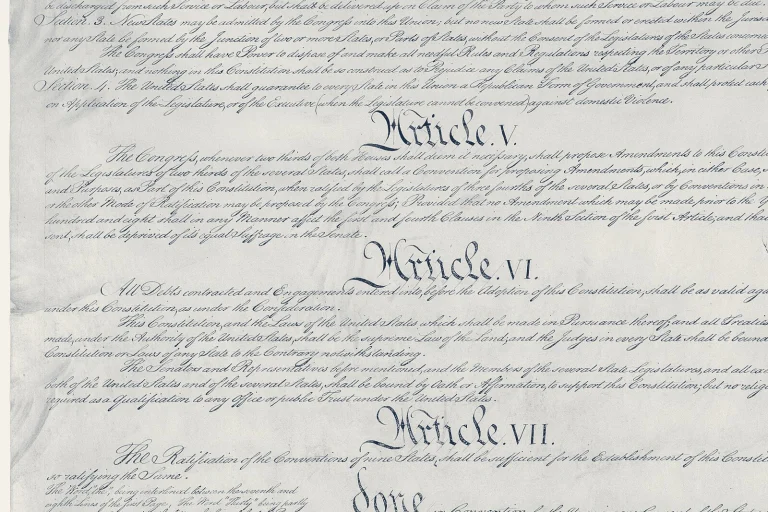
The current enlistment oath does end with “So help me God.” Two details are worth knowing. First, the oath opens “I, ____, do solemnly swear (or affirm),” so the law itself makes room for people who won’t swear a religious oath. Second, “So help me God” was added to the enlistment oath in 1962, several years after “under God” went into the Pledge and the motto law passed. The president’s oath, which is written into the Constitution itself, has no such words.
Why this matters
Taken together, the speech paints the military, and the country, as built on faith in God: a God-fearing force, a God-trusting motto, a God-invoking oath. Pair that with a new office reporting straight to the Secretary and a shorter faith list that’s mostly Christian, and you can see why people are asking questions. The idea that America’s public institutions belong to one faith is at the heart of Christian nationalism. The roughly one in four troops in that “unknown” bucket, and service members of minority faiths or none, are exactly the people a 95% claim leaves out.
The concern isn’t only coming from secular groups. Ann Ritonia, the Episcopal Church’s bishop for the armed forces, said she saw “really good things” in the memo, but that her “initial assessment is that it violates the chain of command.” Franklin Graham, who sits on the White House’s Religious Liberty Commission, called the office “a great idea.”
People can reasonably disagree about whether this office is a good idea. The question here is narrower: is the policy being sold with numbers that hold up? On the 95% claim, they don’t.
What to watch
- October 16: the deadline for airmen and Guardians to update their religious preference, and whether the Pentagon publishes the results
- The memo’s 60- and 90-day deadlines for a budget baseline and a report on “unfunded and underfunded religious affairs requirements”
- Who gets named director. As of October 13, no one has been.
Related claims: “In God We Trust” and “under God” prove America’s Christian founding · America was founded as a Christian nation · Christian nationalism is just patriotism plus faith
Related (added Nov. 23, 2026): “Not whether but which”: Doug Wilson’s Pentagon sermon, checked against the Constitution · Did a judge “muzzle” Brooke Rollins? The USDA religious emails ruling, checked
Sources
- Secretary of War, memorandum establishing the Office of Religious Affairs, Sept. 30, 2026
- Pete Hegseth, State of the Force address, Sept. 30, 2026 (text based on the official transcript)
- Congressional Research Service, R44321, Figure 6 (religious preference data, January 2019)
- George Washington, General Orders, July 9, 1776, Founders Online; U.S. Army, “Army chaplains mark 250 years”
- 10 U.S.C. § 502 (enlistment oath); 36 U.S.C. § 302 (national motto); U.S. Constitution, Article II (presidential oath)
- Pew Research Center, 2023–24 Religious Landscape Study
- Military Times, Oct. 1, 2026; Religion News Service, Oct. 1, 2026; Stars and Stripes, Oct. 2, 2026; American Homefront Project via WHRO, Oct. 12, 2026
Spotted an error? Tell us.
Featured image: aerial view of the Pentagon, May 11, 2021. DOD photo by U.S. Air Force Staff Sgt. Brittany A. Chase; public domain, via Wikimedia Commons. Duotone treatment by Check the Claim.