Verdict: Misleading. Doug Wilson’s Pentagon sermon claimed every society serves a god, so theocracy is only a question of which one. Laws do carry moral judgments. But the Constitution’s authors chose to name no official god or church, and they banned religious tests for federal office.
- The Constitution opens with “We the People” and never names God. The people are the source of the government’s power. Nobody has to worship them.
- James Madison wrote that treating a ruler as “a competent Judge of Religious Truth” was “an arrogant pretension.”
- Calling a secular government a “god” stretches the word. A secular state doesn’t ask anyone to worship it. It leaves worship to each citizen.
What did Doug Wilson say in his Pentagon sermon?
On Tuesday, Nov. 17, Defense Secretary Pete Hegseth hosted pastor Doug Wilson at the Pentagon’s monthly Christian worship service.
Wilson leads Christ Church in Moscow, Idaho, and a small network of churches. Hegseth attends one of them in Washington, D.C.
What happened, in order:
- May 2025: Hegseth held the first Pentagon worship service and pledged to make it monthly (A Public Witness).
- Feb. 17, 2026: Wilson preached there for the first time. A Pentagon spokesman said Hegseth “very much appreciates many of Mr. Wilson’s writings and teachings” (CNN, via NewsChannel 5).
- Nov. 17, 2026: Wilson returned, at Hegseth’s invitation.
Brian Kaylor, a journalist and critic of Christian nationalism, reported the sermon for A Public Witness. No video or transcript was linked, so these quotes come as he reported them:
“You have perhaps been accused of wanting to bring in a theocracy, but again, not whether but which.”
“In secular societies, it is demos, the people. In confused and muddled societies, it is CNN.”
He also said, “It is not whether we impose morality, but rather which morality we impose.”
Hegseth told the crowd, Kaylor reported, that “it is faith and faith alone in Jesus Christ our Lord and Savior that we ultimately submit to and rely upon …” So the sermon made a claim about government itself, and that claim can be checked.
Where does “not whether but which” come from?
The phrase has a source, and Wilson names it. In a 2018 post on his blog, he wrote: “It is, as Rushdoony used to say, not whether but which.”
He added, “It is not whether a society will be theocratic, but rather which θεός the theocratic society will have.” (θεός, pronounced theos, is Greek for “god.” It’s the root of the word “theocracy.”)
R. J. Rushdoony founded Christian Reconstruction, a movement that says the laws God gave ancient Israel still bind every nation. (Our profile of R. J. Rushdoony has more.)
So the Pentagon heard a slogan Wilson credits to that movement’s founder.
What’s the case for “every society has a god”?
The case for it: Wilson’s argument, as he and his allies make it, runs like this:
- Every law enforces someone’s idea of right and wrong.
- So every government answers to some final authority. Wilson calls that authority a society’s “god.”
- In a secular country, he says, that god is “demos, the people.”
The first step holds up. A law against theft, for example, says stealing is wrong.
What doesn’t follow: The rest depends on stretching the word “god.” In the ordinary sense, a god is someone people worship and obey as divine.
A secular government, in the American sense, makes a narrower choice. The state doesn’t pick a god for its citizens. That leaves each person free to worship the God of the Bible, another god, or none.
So the real question is whether the government should choose. The founders answered that on paper.
What does the Constitution say about an official god?
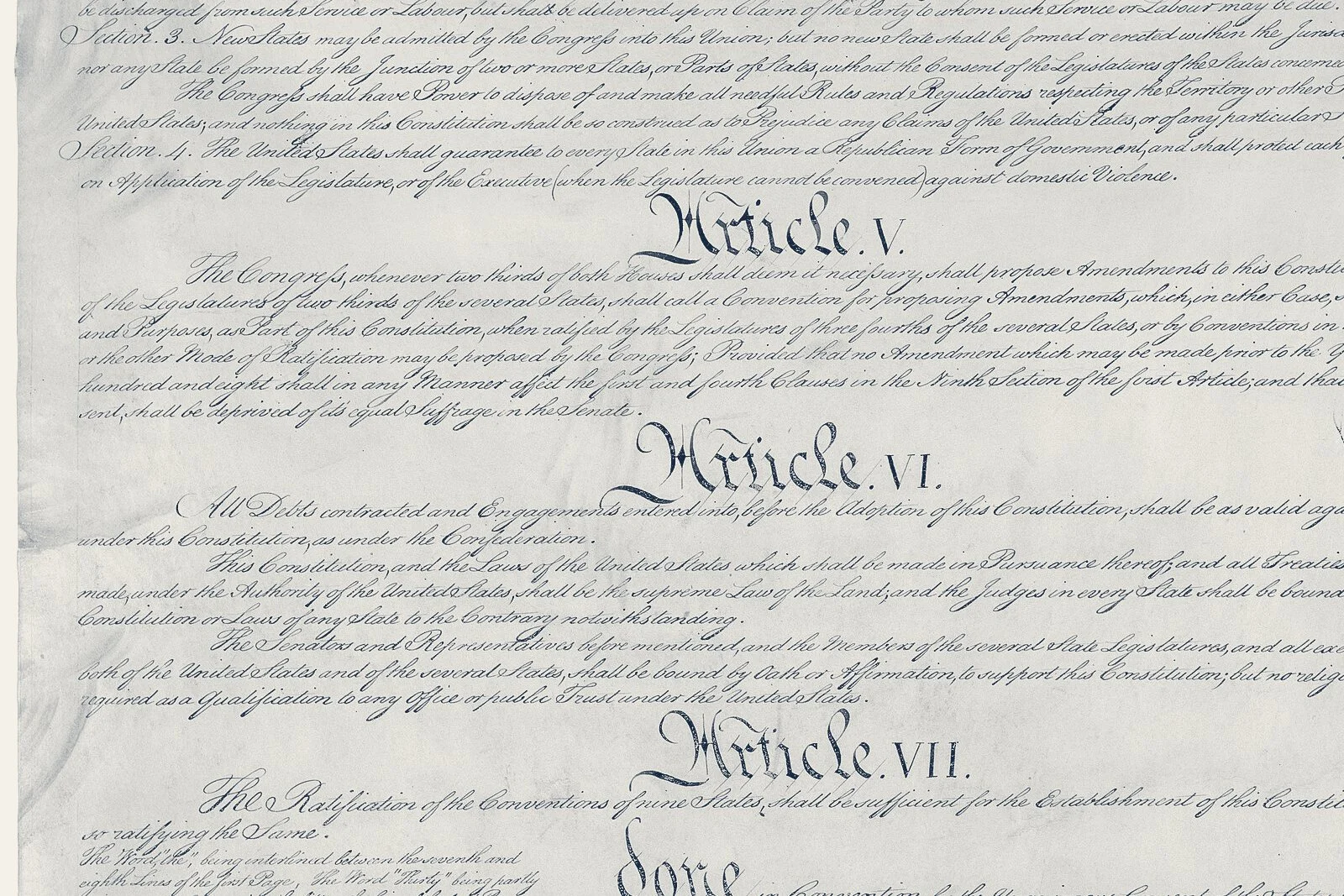
What the record shows: The Constitution begins “We the People of the United States … do ordain and establish this Constitution.” It names no god and no church.
The word “God” never appears. “Lord” appears once, in the date: “in the Year of our Lord.”
Article VI adds that “no religious Test shall ever be required as a Qualification to any Office or public Trust under the United States.” That covers every federal office, including military command.
Then the First Amendment says “Congress shall make no law respecting an establishment of religion.”
What about “endowed by their Creator”?
This is the strongest point for Wilson’s side. The Declaration of Independence (1776) says people are “endowed by their Creator with certain unalienable Rights.” It also speaks of “Nature’s God,” “the Supreme Judge of the world” and “divine Providence.”
So the founding generation did speak of God in public. But the Declaration names no church, no scripture and no Jesus. And it isn’t the law that runs the government. The Constitution, written 11 years later, is.
The Declaration also says where a government’s power comes from. Right after the line about rights, it says: “That to secure these rights, Governments are instituted among Men, deriving their just powers from the consent of the governed.”
In other words, the Declaration says rights come from the Creator, and a government’s power comes from the people. The people hold power over the government, but nobody is asked to worship them. Wilson’s “demos” line blurs those two things.
Did the founders think government could choose the true god?
They argued about it in Virginia in the 1780s. Patrick Henry backed a bill to tax Virginians to pay “Teachers of the Christian Religion.”
James Madison, later the fourth president, wrote the Memorial and Remonstrance against it, and the bill died.
His fifth point goes straight at Wilson’s question. Henry’s bill, Madison wrote, implied “that the Civil Magistrate is a competent Judge of Religious Truth.” (A “civil magistrate” meant a government official.)
But Madison called that idea “an arrogant pretension falsified by the contradictory opinions of Rulers in all ages.”
“Who does not see that the same authority which can establish Christianity, in exclusion of all other Religions, may establish with the same ease any particular sect of Christians, in exclusion of all other Sects?”
James Madison, Memorial and Remonstrance, 1785
Next, in January 1786, Virginia enacted Thomas Jefferson’s statute for religious freedom. It says “our civil rights have no dependence on our religious opinions, any more than our opinions in physics or geometry.”
So Virginia kept its moral laws and refused to make any god the official one.
Engaging the counterargument: isn’t neutrality a myth?
The best version says refusing to name a god just crowns another one, so a neutral government is impossible.
The record shows a working answer. A state can punish theft without ruling on the Trinity. What it can’t do, Madison said, is act as judge of religious truth.
Some conservative Christians make the same point.
Jonathan Leeman, a Baptist church elder who leads the ministry 9Marks, warned against the idea. “Christianizing the government requires that government to establish itself as part church,” he wrote, “a key-wielding judge and declarer of right doctrine.”
That is the role Madison denied any ruler.
Yes, but: Christians who back a more religious government often cite Romans 13:1: “the powers that be are ordained of God.” Those words come from a letter by the apostle Paul. Christians read them alongside Jesus’ words (below) in different ways.
And Wilson’s own question, “which morality,” leads to another: which Christianity would govern?
Who pays the cost when the Pentagon picks a god?
Who pays the cost: Service members of other faiths and none.
The military’s own rule, DoD Instruction 1300.17, recognizes that “Service members have the right to observe the tenets of their religion, or to observe no religion at all.” (Our check of the Pentagon’s religion office and its 95% claim looks at who serves.)
Every officer swears to “support and defend the Constitution,” under federal law. Dan Barker of the Freedom From Religion Foundation put it this way, as quoted by Kaylor: “Our service members swear an oath to defend the Constitution, not Christianity.”
A Muslim lieutenant or a Jewish captain swears that same oath. Under Article VI, the government can’t make their faith a test for the job.
So when the Defense Secretary tells a Pentagon crowd what “we ultimately submit to,” they can fairly ask where they stand.
Do all Christians agree with Wilson?
No. Many Christians have fought this fight from the other side.
Baptists in Massachusetts once paid taxes to support official churches they didn’t belong to. In 1774, Isaac Backus, a Baptist minister in Massachusetts, wrote that “religion is a concern between God and the soul, with which no human authority can intermeddle” (The Founders’ Constitution).
Today, for example, the Baptist Joint Committee’s Christians Against Christian Nationalism statement says, “Government should not prefer one religion over another or religion over nonreligion.”
Christian nationalism erases that line by fusing faith with government power.
In his words
“Jesus answered, My kingdom is not of this world: if my kingdom were of this world, then would my servants fight, that I should not be delivered to the Jews: but now is my kingdom not from hence.” — John 18:36 (KJV)
“Render therefore unto Caesar the things which are Caesar’s; and unto God the things that are God’s.” — Matthew 22:21 (KJV)
“Therefore all things whatsoever ye would that men should do to you, do ye even so to them: for this is the law and the prophets.” — Matthew 7:12 (KJV)
“And when thou prayest, thou shalt not be as the hypocrites are: for they love to pray standing in the synagogues and in the corners of the streets, that they may be seen of men. Verily I say unto you, They have their reward. But thou, when thou prayest, enter into thy closet, and when thou hast shut thy door, pray to thy Father which is in secret; and thy Father which seeth in secret shall reward thee openly.” — Matthew 6:5–6 (KJV)
What’s next?
What’s next: Hegseth has made the services monthly, so expect more guest preachers.
Meanwhile, watch whether the Pentagon says anything about service members who don’t share the faith on stage.
Go deeper: Is separation of church and state in the Constitution? · Was America founded as a Christian nation? · Can Muslims swear allegiance to the Constitution?
Wilson asked which god a nation should serve. The Constitution’s answer was to leave that choice to each citizen and keep it out of the government’s hands.
Related (added Nov. 23, 2026): Did a judge “muzzle” Brooke Rollins? The USDA religious emails ruling, checked
Sources
Primary documents
- U.S. Constitution (Preamble; Article VI), National Archives transcript. https://www.archives.gov/founding-docs/constitution-transcript
- Bill of Rights (First Amendment), National Archives transcript. https://www.archives.gov/founding-docs/bill-of-rights-transcript
- Declaration of Independence (1776), National Archives transcript. https://www.archives.gov/founding-docs/declaration-transcript
- James Madison, Memorial and Remonstrance against Religious Assessments, ca. June 20, 1785, Founders Online. https://founders.archives.gov/documents/Madison/01-08-02-0163
- Act for Establishing Religious Freedom (drafted by Thomas Jefferson), [31 Oct.] 1785, signed Jan. 19, 1786, Founders Online. https://founders.archives.gov/documents/Madison/01-08-02-0206
- Isaac Backus, A History of New England, 1774–75, The Founders’ Constitution (University of Chicago Press). https://press-pubs.uchicago.edu/founders/documents/amendI_religions21.html
- DoD Instruction 1300.17, “Religious Liberty in the Military Services,” Sept. 1, 2020. https://www.esd.whs.mil/Portals/54/Documents/DD/issuances/dodi/130017p.pdf?ver=2020-09-01-151756-730
- 5 U.S.C. § 3331, oath of office, Cornell Legal Information Institute. https://www.law.cornell.edu/uscode/text/5/3331
- Douglas Wilson, “Like a Dog Chasing a Firetruck,” Blog & Mablog, Jan. 15, 2018. https://dougwils.com/books-and-culture/s7-engaging-the-culture/like-dog-chasing-firetruck.html
- Baptist Joint Committee, Christians Against Christian Nationalism statement. https://bjconline.org/christians-against-christian-nationalism/statement/
- John 18:36; Matthew 22:21; Matthew 7:12; Matthew 6:5–6; Romans 13:1–4 (KJV), Bible Gateway.
News and commentary
- Brian Kaylor, “Doug Wilson Makes Case for Christian Theocracy During Pentagon Worship Service,” A Public Witness (Word&Way), Nov. 17, 2026. https://publicwitness.wordandway.org/p/doug-wilson-makes-case-for-christian
- Brian Kaylor, A Public Witness, Feb. 17, 2026 (Wilson’s first Pentagon sermon). https://publicwitness.wordandway.org/p/doug-wilson-preaches-at-pentagon
- Mark Wingfield, “Hegseth ‘doubles down’ on Christian nationalism with more Doug Wilson,” Baptist News Global, Nov. 17, 2026. https://baptistnews.com/article/hegseth-doubles-down-on-christian-nationalism-with-more-doug-wilson/
- Kaanita Iyer and Haley Britzky, CNN, “Hegseth invited pastor who calls for Christian theocracy to lead Pentagon prayer service,” Feb. 2026 (via NewsChannel 5). https://www.newschannel5.com/news/hegseth-invited-pastor-who-calls-for-christian-theocracy-to-lead-pentagon-prayer-service
- Tanya Noury, “Christian nationalist pastor speaks on his sermon to troops at Pentagon,” Military Times, Feb. 20, 2026. https://www.militarytimes.com/news/pentagon-congress/2026/02/20/christian-nationalist-pastor-speaks-on-his-sermon-to-troops-at-pentagon/
- Jonathan Leeman, “A New Christian Authoritarianism?” 9Marks, April 29, 2023. https://www.9marks.org/article/a-new-christian-authoritarianism/
Featured image: Article VI of the U.S. Constitution, page 4 of the original. National Archives (NAID 1667751), public domain, via Wikimedia Commons; cropped and duotoned by Check the Claim.
Spotted an error? Tell us.