Alabama voters approved Amendment 3 on November 3, according to unofficial returns. With all 67 counties reporting early Wednesday, it had 62.6% of the vote. The amendment writes a daily Pledge of Allegiance policy and a student-led prayer policy into the state constitution. It also brings back an old question: is prayer banned in public schools?
Not students’ own prayer. Courts did end school-led prayer and Bible reading in the 1960s, and many families experienced that as prayer being taken away. Students’ own prayer was never banned: the Supreme Court has said so directly, and no ruling we reviewed says otherwise. The claim that prayer was banned from schools is misleading.
What did Alabama voters approve?
The amendment’s text tells every local school board to adopt two policies. One has each public school conduct the Pledge of Allegiance at the start of the day. State law already requires that, with no penalty for a student who declines, under a section of the Alabama Code amended in 2019. The other requires schools to allow a prayer, which “must be initiated by and led by a student.” No student may be required to take part.
- House: 94 yes votes, March 10, 2026 (recorded as 94–3 on LegiScan; the Alabama Reflector reported 94–4)
- Senate: 30–0, April 8, 2026 (LegiScan)
- Voters: unofficial results show 62.6% yes and 37.4% no (974,152 to 582,838) with all 67 counties reporting, as of 2:54 a.m. CST on November 4 (Alabama Political Reporter). The count is not certified. Alabama Political Reporter has called the amendment; we found no Associated Press call.
What’s the case for student-led prayer in public schools?
Supporters describe the amendment as protection for students’ freedom to practice their faith. Sponsor Rep. Reed Ingram (R-Pike Road) said, as reported by WTVM, that administrators would not lead the prayer and that it is “not going to be mandatory for that child to sit and listen to it.” Most of those limits are in the text. Its opt-out covers taking part in the prayer; it does not say whether a student who opts out may leave the room.
The belief behind the support has a real starting point. In 1962, in Engel v. Vitale, the Supreme Court struck down a short prayer that New York officials wrote for classrooms to recite. A year later, in Abington v. Schempp, it struck down required Bible readings and the Lord’s Prayer in Pennsylvania and Baltimore schools. Both rulings said that letting students sit out did not fix the problem. A family that lived through the change can fairly say school prayer stopped.
Is prayer banned in public schools? What the courts barred
The rulings are about who is praying. Engel held that it is “no part of the business of government to compose official prayers.” Abington added that studying the Bible “as part of a secular program of education” remains fine.
Students’ own prayer was never the target. In 2000 the Court put it plainly: nothing in the Constitution, as the Court reads it, bars any public school student “from voluntarily praying at any time before, during, or after the schoolday.” Kennedy v. Bremerton (2022) protected a coach’s quiet personal prayer on the field. The U.S. Department of Education’s February 2026 guidance says students may “pray with fellow students during the school day,” while officials “may not lead students in prayer.” Federal law also protects student religious clubs at federally funded public secondary schools that let other non-curriculum clubs meet (Equal Access Act).
Alabama has tested this line before, most famously in Wallace v. Jaffree (1985), which our October 14 post on Amendment 3 walks through.
Can students pray at school when a board policy sets it up?
The Supreme Court case closest to Amendment 3 is Santa Fe v. Doe (2000), where a Texas district let students vote on whether to have a pregame prayer and who would give it. The Court held that the district’s policy allowing “student-led, student-initiated” prayer at football games violated the Establishment Clause (the part of the First Amendment that bars government from setting up or favoring a religion). It found the school’s role too heavy for the prayer to count as private speech.
Supporters can point to differences: no student vote written into the text, and an opt-out. Skeptics can point out that this is still a school board policy in a room where attendance is required. Rev. Julie Conrady of the Interfaith Alliance of Central Alabama said, in a WSFA report carried by Fox 10, that “students have always been allowed to pray” and that there was no need to put that in the constitution. We are not predicting what a court would do. Settled: students may pray, and schools may not lead or write the prayer. Open: whether a board policy that sets up a student-led prayer counts as private speech.
Why does this matter?
“They took prayer out of schools” carries weight beyond the schoolhouse. For many people it anchors a larger story: that America once had a Christian government that was dismantled and must be restored. That story is central to Christian nationalism, the political ideology that calls for fusing Christian and American identity and for government to favor Christianity. Supporting school prayer is a separate question; as that page notes, many Christians favor prayer in public schools without wanting a Christian state.
The Pledge gained its words “one Nation under God” by a 1954 act of Congress, as our page on the mottos explains, and students cannot be forced to recite it: West Virginia v. Barnette (1943) held, in a case about the earlier wording, that “compelling the flag salute and pledge” crosses constitutional limits. See also separation of church and state.
What to watch
- Certification: the results are unofficial until counties and the state certify them.
- Local policies: each board must write its own rules. A policy protecting students who choose to pray reads differently from one that builds a daily, audible prayer into class time.
- Lawsuits: we found none filed as of November 4.
Related (added Nov. 23, 2026): Did a judge “muzzle” Brooke Rollins? The USDA religious emails ruling, checked
Sources
- Alabama HB 511 (Act 2026-379), enrolled text
- Alabama Fair Ballot Commission, Statewide Amendment 3
- LegiScan, HB 511 (2026) roll calls
- Alabama Reflector, House passage, March 11, 2026
- Alabama 2019 HB 339, enrolled (Code § 16-43-5)
- Alabama Political Reporter, 2026 election results (unofficial; checked Nov. 4, 2:54 a.m. CST)
- WTVM, Oct. 15, 2026
- Fox 10 / WSFA, Oct. 27, 2026
- Engel v. Vitale, 370 U.S. 421 (1962)
- Abington School District v. Schempp, 374 U.S. 203 (1963)
- Wallace v. Jaffree, 472 U.S. 38 (1985)
- Santa Fe Independent School District v. Doe, 530 U.S. 290 (2000)
- Kennedy v. Bremerton School District, 597 U.S. 507 (2022), preliminary print
- West Virginia v. Barnette, 319 U.S. 624 (1943)
- Equal Access Act, 20 U.S.C. § 4071
- U.S. Department of Education, prayer guidance (February 2026)
- Public Law 83-396 (June 14, 1954), 68 Stat. 249
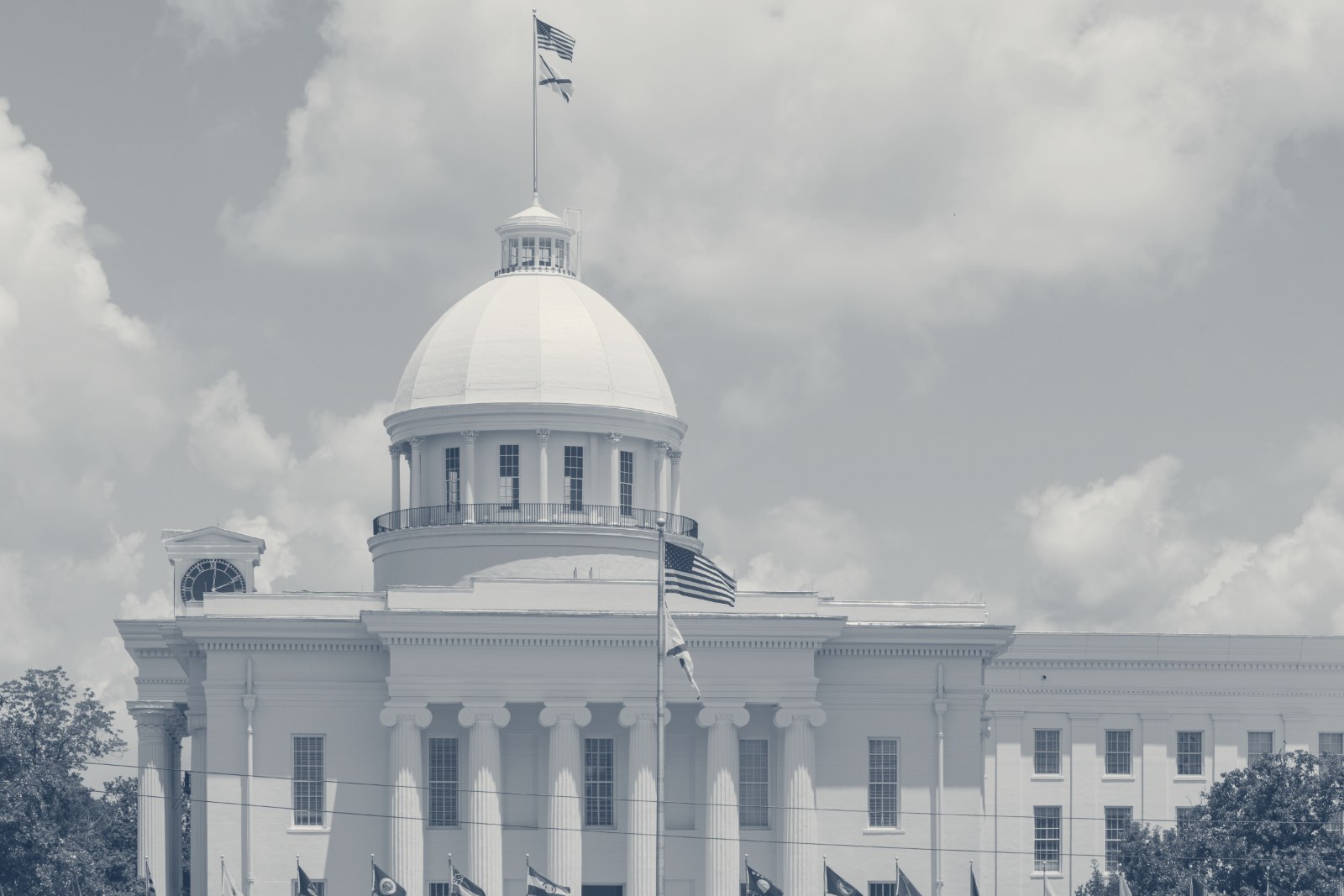
Featured image: Alabama State Capitol, Montgomery, South view. Photo: DXR, CC BY-SA 4.0, via Wikimedia Commons; cropped and duotoned by Check the Claim (CC BY-SA 4.0).
Spotted an error? Tell us.