Yes. Muslim Americans can swear allegiance to the Constitution, and they do. Muslim members of Congress have taken the same oath as everyone else since 2007. The viral claim that they can’t is false.
- The Constitution requires every lawmaker to promise to support it. It also bans any religious test for federal office.
- A U.S. council of Muslim legal scholars has ruled that a Muslim may take the U.S. citizenship oath. That oath includes a promise to support and defend the Constitution.
- A viral sermon said 255 Muslims were elected on Election Day. In fact, that number counts Muslim officials who were already serving, mostly on local councils and in education posts like school boards.
What did Pastor Jack Hibbs say about Muslims and the Constitution?
Can Muslims swear allegiance to the Constitution? A California pastor told his church they can’t, and a clip of his remarks went viral.
Jack Hibbs leads Calvary Chapel Chino Hills, a church in Southern California. He also hosts a broadcast called Real Life with Jack Hibbs. Here’s how the story unfolded:
- Nov. 3: Americans voted in the midterm elections.
- Nov. 4: His church’s website lists a “Post Election Communion” service that day. The clip appears to come from it. However, we couldn’t play the video, so the quotes below are as reported.
- Nov. 10–11: The clip spread on X, and ChurchLeaders reported that Hibbs posted it himself. WND, Gateway Pundit and ChurchLeaders covered it.
According to ChurchLeaders, Hibbs said: “Two hundred and fifty five Muslims were elected to office in the United States of America on Tuesday.” Then he added: “Two hundred and fifty five Muslims who cannot swear allegiance to the Constitution. It is forbidden in Islam. They must swear allegiance to sharia law, which is a completely different government.”
He also declared, “The republic ended on Tuesday,” and scolded churchgoers who stayed home. (We checked that turnout claim in Did evangelicals stay home in 2026?)
That’s strong language. But underneath it are two claims we can check: where the 255 came from, and whether Muslim officials can take the oath.
Where does the 255 number come from?
What the record shows: The number is real, but it counts something else.
On Aug. 20, the Council on American-Islamic Relations (CAIR), a Muslim civil rights group, published a directory of Muslim elected officials. It counted “255 Muslim elected officials serving across 26 states.” Here’s where they serve:
- 98 on local councils
- 63 in education posts, such as school boards
- 46 in state legislatures
- 18 judges and 11 mayors
- 4 in the U.S. House
Then, two days after the vote, CAIR’s early count was at least 97 Muslim winners, including incumbents who won reelection. (For the bigger picture, see Did an “unholy alliance” win the 2026 midterms?) So the 255 were already in office months before anyone voted “on Tuesday.”
What’s the case that Muslims can’t swear to the Constitution?
The case for it: People who believe this can point to real ideas and real groups.
- God’s law comes first. Sharia is Islamic religious law. Even Muslim teachers who allow the oath say ultimate loyalty belongs to God. For example, one Muslim scholar wrote in October that “Absolute, unconditional allegiance belongs to Allah and His Messenger … alone.” Yet the same answer says the oath is “permitted.”
- Some Islamist groups do forbid it. Hizb ut-Tahrir is an international Islamist party that wants to restore a caliphate, a single Islamic state. Its 2003 ruling for Muslims in Europe says taking part in Western elections is “Haraam,” or forbidden (Hizb ut-Tahrir).
- The worry isn’t new. In 2015, Ben Carson, then running for president, was asked if Islam is consistent with the Constitution. He answered: “No, I don’t, I do not.”
Still, notice what Hizb ut-Tahrir’s ruling admits. A Muslim in office, it says, “must defend these laws and guard them.” That’s exactly why the group tells Muslims to stay out. So Muslims who run for office have already set that view aside.
Can Muslim officials swear allegiance to the Constitution?
What the record shows: Yes. The Constitution requires the oath, and Muslim officials take it.
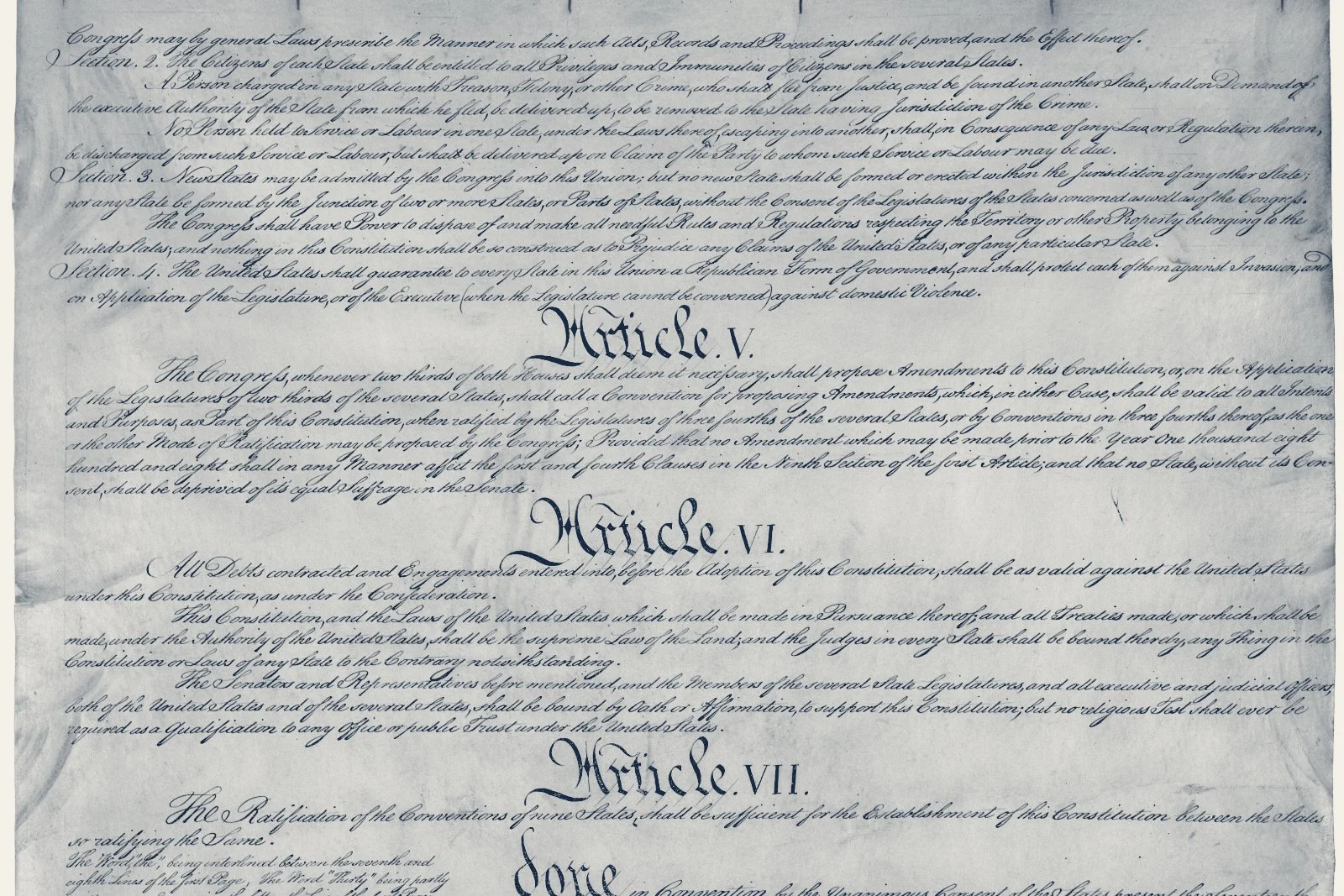
First, Article VI says lawmakers and officials “shall be bound by Oath or Affirmation, to support this Constitution.” The same sentence ends: “no religious Test shall ever be required as a Qualification to any Office” (National Archives). A religious test is a rule that you must hold a certain faith to serve.
Federal law also sets the oath’s wording. Each official promises to “support and defend the Constitution of the United States” and to “bear true faith and allegiance to the same” (5 U.S.C. 3331).
Have Muslim members of Congress taken the oath?
Yes. On the first day of each Congress, the Speaker of the House swears in all members at once (House Practice).
Keith Ellison of Minnesota, the first Muslim elected to Congress, took that oath on Jan. 4, 2007 (Baptist News Global). At a separate ceremony afterward, he held a Quran once owned by Thomas Jefferson (NPR). Since then, André Carson, Ilhan Omar, Rashida Tlaib and Lateefah Simon have also taken the oath and served (Pew Research Center).
What do Muslim scholars say?
The Assembly of Muslim Jurists of America is a U.S. council of Islamic legal scholars. It was asked whether a Muslim can take the oath to become a citizen. Its answer: “Yes, a Muslim can take the U.S. oath of allegiance to become a citizen.”
In fact, that citizenship oath is even stronger than the one for office. New citizens “absolutely and entirely renounce” other loyalties and promise to “support and defend the Constitution” (8 CFR 337.1).
Yes, but: Muslim teachers do say God comes first. So do many Christians. Even so, the oath never mentions God’s law or asks anyone to rank it. That’s why officials of every faith can say the same words.
Has America heard this argument before?
Yes, at the founding. In 1788, North Carolina held a convention to decide whether to ratify the Constitution. There, a delegate named William Lancaster objected to the ban on religious tests. He warned that “Papists may occupy that chair, and Mahometans may take it” (North Carolina convention, July 30, 1788). “Papists” meant Catholics. “Mahometans” was the old word for Muslims.
James Iredell, later a Supreme Court justice, answered him. You can’t shut out one faith, he argued, without giving up your own freedom. In his words: “how is it possible to exclude any set of men, without taking away that principle of religious freedom which we ourselves so warmly contend for?” (Iredell’s speech).
Meanwhile, Virginia had settled the question two years earlier. Jefferson’s statute for religious freedom ended with this promise:
“[A]ll men shall be free to profess, and by argument to maintain, their opinion in matters of religion, and that the same shall in no wise diminish, enlarge, or affect their civil capacities.”
Act for Establishing Religious Freedom, Virginia, 1786
“Civil capacities” means a citizen’s standing under the law, including the right to hold office. So the founders’ answer to “can a Muslim serve?” is already on paper.
Go deeper: Is the U.S. Constitution a Christian document? and Was America founded as a Christian nation?
Who pays the cost of a religious test?
Who pays the cost: First, Muslim Americans who serve or want to. If their oath doesn’t count, then neither does their service.
Other groups have also paid that price. For example, North Carolina’s 1776 constitution barred anyone who denied “the truth of the Protestant religion” from office. That shut out Catholics and Jews. It also barred anyone holding “religious principles incompatible with the freedom and safety of the State” (Avalon Project). That’s close to Hibbs’s charge today.
Later, in 1960, the target was a Catholic once again. Senator John F. Kennedy, running for president, went to Houston to answer Protestant ministers’ doubts about his faith. He told them: “Today I may be the victim, but tomorrow it may be you” (NPR transcript).
That’s why the claim matters. Judging fitness for office by faith fits Christian nationalism: the belief that America is, or should be, a Christian nation, with government favoring that faith.
Do all Christians see it this way?
No. Even in 1788, a Massachusetts minister, the Rev. Daniel Shute, defended the ban on religious tests. Who should be kept out of national office? His answer: “the dictates of candor and equity, I conceive, will be, None” (Massachusetts convention).
Today, too, a Baptist group, the Baptist Joint Committee for Religious Liberty, runs a campaign called Christians Against Christian Nationalism. Its statement says, “One’s religious affiliation, or lack thereof, should be irrelevant to one’s standing in the civic community.”
Jesus said:
“Therefore all things whatsoever ye would that men should do to you, do ye even so to them: for this is the law and the prophets.” (Matthew 7:12, KJV)
What to watch
- January swearing-in. New Muslim members of Congress will take the same oath, at the same moment, as everyone else.
- Calls for religious tests. In July, Indiana’s lieutenant governor, Micah Beckwith, said he wants to amend his state’s constitution to bring back a religious oath for office. “I want to go back to the way it was in the first 13 state constitutions,” he told a town hall (The Indiana Citizen). He added that this “doesn’t mean you have to be a Christian.” So watch whether “they can’t take the oath” turns into “they shouldn’t be allowed to.”
Related (added Nov. 23, 2026): Does a Muslim prayer at a city meeting go against America’s founding? What happened in Bartow
Sources
Statements
- Jack Hibbs, as quoted by Dale Chamberlain, “Pastor Jack Hibbs Says ‘The Republic Is Over’ After Muslim Candidates Win Midterm Elections,” ChurchLeaders, Nov. 11, 2026. https://churchleaders.com/news/2225461-pastor-jack-hibbs-republic-is-over.html
- Jim Hoft, “American Pastor Sounds Alarm After Midterms,” Gateway Pundit, Nov. 10, 2026. https://www.thegatewaypundit.com/2026/11/american-pastor-sounds-alarm-after-midterms-255-muslims/
- Joe Kovacs, “‘Prepare your children’: U.S. pastor clobbers Christians who didn’t vote,” WND, Nov. 10, 2026. https://www.wnd.com/2026/11/prepare-your-children-u-s-pastor-clobbers-christians/
- Calvary Chapel Chino Hills, “Post Election Communion,” Nov. 4, 2026. https://calvarycch.org/post-election-communion/
- Ben Carson on Meet the Press, Sept. 20, 2015, NBC News release. https://nbcuniversalnewsgroup.com/nbcnews/2015/09/20/mtp-sunday-exclusive-gop-candidate-ben-carson-i-would-not-advocate-that-we-put-a-muslim-in-charge-of-this-nation/
- Hizb ut-Tahrir Europe, “The Ruling on Muslim Participation in the Political Life of the West” (2003). https://issuu.com/hizb_ut_tahrir/docs/eu-political-participation-english
Laws, records and founding documents
- U.S. Constitution, Article VI, National Archives transcript. https://www.archives.gov/founding-docs/constitution-transcript
- 5 U.S.C. 3331, Oath of office. https://www.govinfo.gov/content/pkg/USCODE-2011-title5/html/USCODE-2011-title5-partIII-subpartB-chap33-subchapII-sec3331.htm
- 8 CFR 337.1, Oath of allegiance (naturalization). https://www.law.cornell.edu/cfr/text/8/337.1
- House Practice, ch. 33, “Oaths.” https://www.govinfo.gov/content/pkg/GPO-HPRACTICE-115/html/GPO-HPRACTICE-115-34.htm
- Act for Establishing Religious Freedom, Virginia, 1786; text from the Papers of James Madison (bill as introduced [31 Oct.] 1785), Founders Online. https://founders.archives.gov/documents/Madison/01-08-02-0206
- William Lancaster and James Iredell, North Carolina ratifying convention, July 30, 1788, Center for the Study of the American Constitution. https://archive.csac.history.wisc.edu/lancaster_in_convention7.30.pdf and https://archive.csac.history.wisc.edu/iredell_in_convention7.30.pdf
- Rev. Daniel Shute, Massachusetts ratifying convention, 1788, The Founders’ Constitution (from Elliot’s Debates, dated there Jan. 30, 1788). https://press-pubs.uchicago.edu/founders/documents/a6_3s20.html
- Constitution of North Carolina, 1776, Avalon Project. https://avalon.law.yale.edu/18th_century/nc07.asp
- John F. Kennedy, address to the Greater Houston Ministerial Association, Sept. 12, 1960, NPR transcript. https://www.npr.org/2007/12/05/16920600/transcript-jfks-speech-on-his-religion
Data, scholars and organizations
- CAIR and CAIR Action, “Record-Breaking: CAIR, CAIR Action Identify 255 Muslim Elected Officials in New 2026 Directory,” Aug. 20, 2026. https://cairaction.org/press-release/record-breaking-cair-cair-action-identify-255-muslim-elected-officials-in-new-2026-directory/
- CAIR and CAIR Action, “BREAKING: CAIR, CAIR Action Report Record 97 Muslims (and Counting) Elected Nationwide,” Nov. 5, 2026. https://www.cair.com/press_releases/breaking-cair-cair-action-report-record-97-muslims-and-counting-elected-nationwide/
- Pew Research Center, “Faith on the Hill,” Jan. 2, 2025. https://www.pewresearch.org/religion/2025/01/02/faith-on-the-hill-2025/
- NPR, “Ellison to Take Oath on Thomas Jefferson’s Quran,” 2007. https://www.npr.org/transcripts/6718662
- Religious Herald/RNS, “Muslim congressman uses Jefferson’s Quran to take oath of office,” Baptist News Global, Jan. 10, 2007. https://baptistnews.com/article/muslimcongressmanusesjeffersonsqurantotakeoathofoffice/
- Assembly of Muslim Jurists of America, fatwa 83225, “US Citizenship Oath of Allegiance,” 2010. https://www.amjaonline.org/fatwa/en/83225/us-citizenship-oath-of-allegiance
- SeekersGuidance, “May a Muslim Swear Allegiance to a Constitution That Prevails Over Religious Law?” Oct. 16, 2026. https://seekersguidance.org/answers/oath-allegiance-constitution-religious-law/
- Baptist Joint Committee for Religious Liberty, Christians Against Christian Nationalism statement. https://www.christiansagainstchristiannationalism.org/statement
- Sydney Byerly, “Religious Oath: Lt. Gov. Beckwith Wants Indiana Candidates to Attest Belief in ‘Judeo-Christian Orthodoxy,’” The Indiana Citizen, July 30, 2026. https://indianacitizen.org/religious-oath-gov-beckwith-wants-indiana-candidates-to-attest-belief-in-judeo-christian-orthodoxy/
- Brian Kaylor, “Flunk Those Who Want a Religious Test for Office,” Word&Way, Aug. 11, 2026. https://wordandway.org/2026/08/11/flunk-those-who-want-a-religious-test-for-office/
Featured image: Page 4 of the U.S. Constitution, with Article VI, by the Constitutional Convention, 1787. National Archives, public domain, via Wikimedia Commons; cropped and duotoned by Check the Claim.
Spotted an error? Tell us.