No. Muslim voters and self-described democratic socialists did vote heavily Democratic on Nov. 3. But the “unholy alliance” story leaves out scale: Muslims were about 1 in 100 voters, and the swing that decided the midterm elections came from much larger groups. That makes the claim misleading.
- Muslim voters went about 86% Democratic. But they were only about 1% of all voters, too few to decide a national election.
- The big shifts came from independents, Latino voters and young voters. The economy topped voters’ list of issues.
- The “unholy alliance” idea is older than this election. In its harshest form, it treats ordinary Muslim neighbors as part of a plot.
Who says an unholy alliance won the midterm elections?
Did an “unholy alliance” win the midterm elections? In the week after Democrats took the House and the Senate on Nov. 3, several prominent voices said yes.
- Nov. 8: Jason Rapert, a former Arkansas state senator who founded the National Association of Christian Lawmakers, published a 16-page open letter on the group’s website.
- Nov. 11: Evangelist Franklin Graham posted on X that the late activist Charlie Kirk had warned of an “unholy alliance.”
Rapert wrote that “Islamists, abortion zealots, Satanists, communists, socialists, marxists, antisemites, LGBTQ activists and anarchists work together to topple the United States of America.”
Graham was more direct about the vote: “We saw evidence of this alliance most recently in the outcome of the U.S. midterm elections.” The rest of his post calls it “a convergence of Islamists and the far left, including socialists and LGBTQ activists.”
We checked a related Muslim-turnout claim in Did Christian nationalism lose the midterms? This post checks the bigger one: that an alliance decided the election.
What’s the case for the “unholy alliance” claim?
The case for it: To be fair, people who make this argument can point to real things.
- Muslim voters went 86% to 11% for Democrats in this year’s network exit poll, a single survey by the polling firm SSRS that NBC, the AP and other news outlets share. Abdul El-Sayed of Michigan became the first Muslim elected to the U.S. Senate, and a record seven Muslims won House seats (RNS).
- In the same poll, 18% of voters called themselves democratic socialists. Of those, 98% voted Democratic.
- Some Muslim groups did work for Democrats. The political arm of the Council on American-Islamic Relations (CAIR), a Muslim civil rights and advocacy group, endorsed Democrats in Texas (RNS).
Rapert also points to Islamist groups abroad, like the Islamic State, that have persecuted Christians. So the pieces are real. The question is whether they add up to what the claim says.
Did Muslim voters swing the 2026 midterms?
What the record shows: The numbers are too small to carry the claim.
Muslims make up “only about 1% of the adult population in the United States,” according to Pew Research Center. The exit poll also found 1% among voters. So Muslim voters added about one point, at most, to the Democrats’ national margin.
Now compare independents. They were a third of all voters, and they went 58% to 38% for Democrats. That’s worth more than six points of margin by itself. By contrast, in 2024 they split almost evenly in that year’s exit poll. (The 2026 exit poll uses a new method, so comparisons with 2024 are rough; see Did half of evangelicals stay home in 2026?)
Other groups moved, too. About 6 in 10 Hispanic voters backed Democrats for the House, the AP found in its report on the same survey. In 2024, about 4 in 10 had backed Trump (AP). About 7 in 10 voters under 30 also went Democratic, up from 54% for Harris in the 2024 exit poll.
Voters also said why. “About 4 in 10 voters say the economy is the top issue facing the country,” the AP reported.
Yes, but: Muslim voters aren’t a fixed bloc. In 2024, CAIR’s own exit poll found only about 20% backed Kamala Harris. This year, 70% told CAIR’s survey that rising hostility toward Muslims made them want to vote. By CAIR’s numbers, this year’s swing back was partly a reaction to hostility.
What about the democratic socialists?
They’re a much bigger group: 18% of voters, and 98% of them voted Democratic. Leave them out, and Republicans won the other 81% of voters, 52% to 46%. But the same math works for any loyal bloc. Leave out white evangelicals, who went 82% Republican, and Democrats won everyone else 63% to 35%.
A label in a poll also isn’t an alliance. The poll doesn’t show these voters working with Muslim groups, and it can’t show whether the group grew: the 2024 exit poll didn’t ask the question. The changes we can measure came from independents, Latino voters and young voters.
Where does the phrase “unholy alliance” come from?
The idea didn’t start with this election. In 2004, writer David Horowitz published Unholy Alliance: Radical Islam and the American Left. Before the vote, an Oct. 31 Washington Times opinion podcast used it too, along with another name for the same idea: “red-green alliance.” A July 30 policy brief from the Center for Renewing America, a policy group, uses the same label.
In the clip Graham shared, Kirk says “the enemies are wokeism or Marxism combining with Islamism.” We found no record that Kirk took the idea from Horowitz.
In its political sense, Islamism is “a popular reform movement advocating the reordering of government and society in accordance with laws prescribed by Islam” (Merriam-Webster). Graham’s post doesn’t say which Islamists he means. But elections are decided by voters. So blaming an election result on “Islamists” quietly turns Muslim voters into members of a movement. Rapert says it outright: “The greatest fallacy being spoken in our country today is that Islam is different than radical Islam. No it is not.”
The Center for Renewing America’s brief made that swap on paper. In August, it warned of “radical Islamists” (archived copy). By October, the same brief, still dated July 30, warned of “Muslims” instead (current version).
Who pays the cost of this claim?
Who pays the cost: Muslim Americans do, first. Rapert’s letter says “Our nation should never have allowed Islam to take root in our country.” He calls the result “a serious enemy within.” Muslim groups already face official action in at least one state. Texas Gov. Greg Abbott has labeled CAIR a terrorist group, and CAIR is fighting that in court (RNS).
Update, Nov. 17, 2026: A separate lawsuit, filed in February by Texas Attorney General Ken Paxton’s office to have a court declare CAIR a terrorist organization, was dropped on Nov. 16 (Texas Tribune). CAIR’s own federal challenge to Abbott’s designation is a different case. Governor-elect Gina Hinojosa has said she will remove the designation after she takes office.
That points to the core of Christian nationalism: the demand that government declare America a Christian nation (see how Christian nationalism differs from patriotism). In that picture, other faiths become outsiders. It also paints the other party as an enemy of the faith, a claim we check in “Democrats are hostile to Christianity.”
Beyond that, it turns neighbors into enemies. Lance Wallnau is a Christian author (his bio) who promotes the Seven Mountains idea: that Christians should take charge of key areas of society, such as government, education and media.
After the vote, he posted that the “real story behind why we lost” is that “The Prince of the power of the air has been given unprecedented access to the powers of media.” The phrase comes from Ephesians 2:2. It’s the language we trace in “Our political fight is spiritual warfare.” Language like this makes an election loss feel like a spiritual attack.
Yet the people it describes are ordinary voters. In CAIR’s survey, 80% of Muslim voters said the economy was a major influence on their vote.
Do all Christians see it this way?
Many Christians reject the “enemy within” idea. The Christians Against Christian Nationalism statement, from the Baptist Joint Committee for Religious Liberty, says, “America has no second-class faiths.”
Asked “who is my neighbour?”, Jesus told a story about a Samaritan who stopped to help a man who had been robbed and beaten (Luke 10:29–37). It ends this way:
“Which now of these three, thinkest thou, was neighbour unto him that fell among the thieves? And he said, He that shewed mercy on him. Then said Jesus unto him, Go, and do thou likewise.” (Luke 10:36–37, KJV)
Is Islam foreign to America’s founding?
Rapert’s letter also makes a historical case. It says every colony and state “once required those running for public office to be Christians or as in one state to declare a belief in God.”
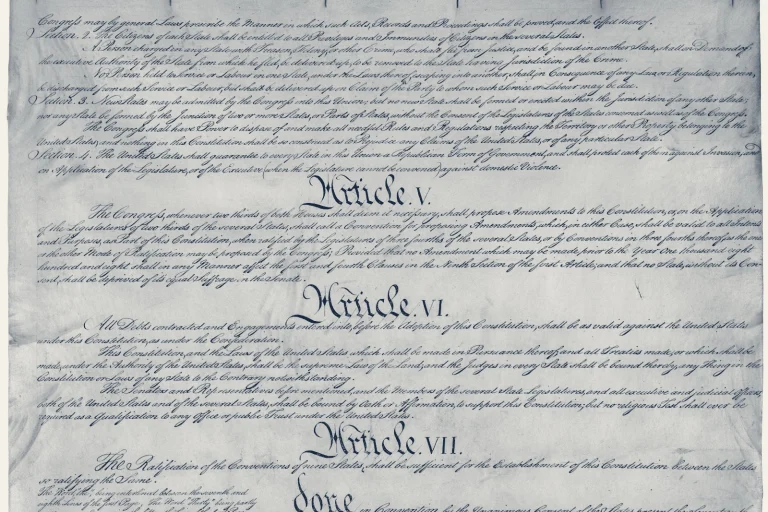
He has a point about some early states (we trace that history in The colonies are not the founding). Delaware’s 1776 constitution, for example, made officeholders profess faith “in Jesus Christ” (Avalon Project). But the U.S. Constitution ruled that out for federal office from the start: “no religious Test shall ever be required” (Article VI).
Virginia had already gone further. In 1785, Virginians fought off a proposed tax to pay Christian religious teachers (Founders Online). Then lawmakers passed Thomas Jefferson’s religious freedom law. Jefferson later wrote that they meant it to protect “the Christian and Mahometan” (an old word for Muslim) alike (Monticello). (See also our page on the Treaty of Tripoli.)
“[N]o man shall be compelled to frequent or support any religious worship, place, or ministry whatsoever … all men shall be free to profess, and by argument to maintain, their opinion in matters of religion.”
Virginia Act for Establishing Religious Freedom, 1786 (Founders Online)
So the founding record points the other way. It barred religious tests for federal office, and Virginia’s law was written to protect Muslims as well as Christians.
What to watch
- Better data. Exit polls are early estimates. After past elections, Pew Research Center has checked survey answers against voter files (Pew), a better test of who voted.
- New laws. Watch whether this talk turns into more bills or official action aimed at Muslim groups.
Related (added Nov. 16, 2026): Can Muslims swear allegiance to the Constitution?
Sources
Statements and news
- Jason Rapert, “Where Does America Go From Here?” open letter, National Association of Christian Lawmakers, Nov. 8, 2026. https://img1.wsimg.com/blobby/go/c2cfc7ff-7938-4e33-8a9c-95efd93ed0d9/NACL_JasonRapert_OpenLetterToTheNation_Novembe.pdf
- National Association of Christian Lawmakers, “From the Desk of Jason Rapert” (links the letter). https://christianlawmakers.com/jason-rapert
- Arkansas State Legislature, Senator Jason Rapert member page (“Public Service: Senate 2011 … 2021”). https://www.arkleg.state.ar.us/Legislators/Detail?member=Rapert&ddBienniumSession=2021%2F2021R
- Franklin Graham, X post, Nov. 11, 2026. https://x.com/Franklin_Graham/status/2120540079047213125
- Lance Wallnau, X post, Nov. 10, 2026. https://x.com/lancewallnau/status/2120268561113645058 ; bio: https://lancewallnau.com/about/
- John Fea, “Evangelical roundup for November 12, 2026” (embeds posts by Franklin Graham, Daniel Cohen, Lance Wallnau and David Brody). https://thewayofimprovement.blog/2026/11/12/evangelical-roundup-for-november-12-2026/
- Mona Khalifeh, “Franklin Graham Says Charlie Kirk Warned of ‘Unholy Alliance’ Threatening America Before His Death,” National Enquirer, Nov. 11, 2026. https://nationalenquirer.com/franklin-graham-says-charlie-kirk-warned-of-unholy-alliance-threatening-america-before-his-death/
- Ulaa Kuziez, “Anti-Muslim attacks didn’t help Republican candidates. In Texas, they may have hurt,” Religion News Service, Nov. 12, 2026. https://religionnews.com/2026/11/12/anti-muslim-attacks-didnt-help-republican-candidates-in-texas-they-may-have-hurt/
- David Horowitz, Unholy Alliance: Radical Islam and the American Left (Regnery, Sept. 2004), Open Library record. https://openlibrary.org/books/OL8250548M
- Cheryl K. Chumley, “WATCH: An unholy Islamist-Democrat alliance is brewing” (opinion, video), Washington Times, Oct. 31, 2026. https://www.washingtontimes.com/news/2026/oct/31/bold-blunt-unholy-islamist-democrat-alliance-brewing/
- Wade Miller, “Policy Brief: Assessing the Marxist-Muslim Alliance Aimed at America’s Heart,” Center for Renewing America, dated July 30, 2026 (current version). https://americarenewing.com/issues/policy-brief-assessing-the-marxist-muslim-alliance-aimed-at-americas-heart/
- Same brief, earlier version titled “Assessing the Marxist-Islamist Alliance,” Internet Archive, Aug. 10, 2026. https://web.archive.org/web/20260810182034/https://americarenewing.com/issues/policy-brief-assessing-the-marxist-islamist-alliance-aimed-at-americas-heart/
Polls and data
- NBC News, 2026 midterm exit polls (source: SSRS). https://www.nbcnews.com/politics/2026-elections/exit-polls
- NBC News, 2024 exit polls (National Election Pool). https://www.nbcnews.com/politics/2024-elections/exit-polls
- Associated Press, “AP Voter Poll: How key demographic groups voted in the 2026 midterms,” Nov. 3, 2026 (via PBS NewsHour). https://www.pbs.org/newshour/politics/ap-voter-poll-how-key-demographic-groups-voted-in-the-2026-midterms
- Associated Press, “Latino voters propel Democrats to big wins with leftward swing,” Nov. 6, 2026 (via PBS NewsHour). https://www.pbs.org/newshour/politics/latino-voters-propel-democrats-to-big-wins-with-leftward-swing
- Besheer Mohamed, “How U.S. Muslims compare with other Americans religiously and demographically,” Pew Research Center, June 18, 2025. https://www.pewresearch.org/short-reads/2025/06/18/how-us-muslims-compare-with-other-americans-religiously-and-demographically/
- Pew Research Center, methodology for its 2024 validated-voter study, June 26, 2025. https://www.pewresearch.org/politics/2025/06/26/validated-voters-2024-methodology/
- CAIR (advocacy group), 2024 exit poll of Muslim voters. https://www.cair.com/press_releases/cair-exit-poll-of-muslim-voters-reveals-surge-in-support-for-jill-stein-and-donald-trump-steep-decline-for-harris/
- CAIR and CAIR Action, “Exit Survey: Muslim Voters” (2026; 522 registered Muslim voters, Nov. 2–4). https://muslims.vote/wp-content/uploads/2026/11/CAIR_CAIR_Action_2026_Exit_Survey_Muslim_Voters.pdf
Founding documents and references
- U.S. Constitution, Article VI, National Archives transcript. https://www.archives.gov/founding-docs/constitution-transcript
- Delaware Constitution of 1776, Art. 22, Avalon Project, Yale Law School. https://avalon.law.yale.edu/18th_century/de02.asp
- Merriam-Webster, “Islamism.” https://www.merriam-webster.com/dictionary/Islamism
- James Madison, Memorial and Remonstrance against Religious Assessments, ca. June 20, 1785, Founders Online. https://founders.archives.gov/documents/Madison/01-08-02-0163
- Thomas Jefferson, draft autobiography, Feb. 6, 1821 (Library of Congress manuscript), via Thomas Jefferson’s Monticello. https://tjrs.monticello.org/node/1399
- Act for Establishing Religious Freedom, 1786, Founders Online. https://founders.archives.gov/documents/Madison/01-08-02-0206
- Baptist Joint Committee for Religious Liberty, Christians Against Christian Nationalism statement. https://www.christiansagainstchristiannationalism.org/statement
Featured image: “Vote Here” sign in Minneapolis, Minnesota, Nov. 3, 2020. Photo: Lorie Shaull, CC BY-SA 2.0, via Wikimedia Commons; cropped and duotoned by Check the Claim (CC BY-SA 2.0).
Spotted an error? Tell us.