Correction (Nov. 17, 2026): An earlier version said Everett’s posted guidelines limit released time to lunch and/or recess and require a written request for each release. Those guidelines are no longer online, so that item now cites the Everett Herald’s report on when the classes meet.
On October 13, 2026, the school board in Everett, Washington, voted to settle a federal lawsuit brought by LifeWise Academy, a Christian program that teaches Bible classes to public school students during the school day, off campus, with parents’ permission. The district agreed to pay $275,000 (which LifeWise’s lawyers say covers attorney’s fees), to get religious-liberty training for the board, and to post a public apology on its website. According to the Everett Herald, the district did not admit wrongdoing.
The apology, posted October 14, says: “The District apologizes for the frustration and difficulty its actions caused those students and families.” The board also apologized for comments made about LifeWise at its meetings.
This is a story we think belongs on a site about Christian nationalism, because it tests two claims that get repeated from opposite directions.
What happened
LifeWise, an Ohio-based nonprofit founded in 2018, runs what’s called “released time”: with a parent’s written permission, students leave school during the day to attend a Bible class at a nearby church. No public money pays for it. The Washington State Standard reports LifeWise expected to serve nearly 100,000 students in 34 states last school year.
In Everett, the program started in January 2025 at a church near Emerson Elementary. That fall the district adopted new rules. LifeWise and a parent, Sarah Sweeny, sued in December 2025, saying the district singled the program out. Among their complaints: a new permission slip for every single week, LifeWise’s exclusion from the district’s community resource fair, and a rule that anything students brought back from class had to be sealed in an envelope in their backpacks.
The lawsuit also pointed to a school board member, Charles Adkins. At a December 2025 board meeting he said, “I do in fact hold animus toward LifeWise Academy.” The complaint says he had earlier described the program’s aim as “bring[ing] white supremacy and Christian nationalism to our schools.”
In April 2026, U.S. District Judge Lauren King issued a preliminary injunction, an early court order that applies while a case goes on. She ruled that LifeWise was likely to win on several points. On the resource fair, she wrote: “In doing so, the District has engaged in viewpoint discrimination.” She also agreed with the plaintiffs on the sealed envelopes, quoting their brief: “A student cannot read a Bible that is sealed in an envelope in her backpack.”
The fair case for the district
The district’s side deserves a hearing. In court, it argued that many of LifeWise’s contentions were “simply untrue”, that a board member speaks only for himself, and that it was trying to avoid the impression that it endorsed LifeWise’s religious program. Those are real concerns. Public schools aren’t supposed to promote a faith, and the judge’s order was preliminary; the case never reached a final ruling. She also turned down some of what LifeWise asked for as too vague or broader than necessary.
Critics elsewhere raise other fair questions about released-time programs: kids lose class time, and some parents have complained about student-to-student recruiting. Reasonable people can dislike the program. The court’s question was narrower: whether a school can treat a religious program worse than comparable secular ones.
What the record shows
Released time is old. A school superintendent named William Wirt started one of the first programs in Gary, Indiana, in 1914. And the Supreme Court drew the legal line decades ago.
In McCollum v. Board of Education (1948), the Court struck down a program in Champaign, Illinois, where religious teachers taught inside public school classrooms. Four years later, in Zorach v. Clauson (1952), it upheld New York City’s program, where students left the building. The difference, Justice William O. Douglas wrote, was that in Champaign “the classrooms were turned over to religious instructors,” while New York’s schools “do no more than accommodate their schedules to a program of outside religious instruction.” Three justices dissented, and the debate over released time has never fully gone away.
So the arrangement LifeWise uses is the one the Supreme Court approved in 1952. In the majority’s view, that kept church and state apart: the church teaches, and the school only adjusts its schedule. The dissenters saw it as the school lending its authority to religion, and some critics of released time still do.
Why this matters
Two claims run into this case.
The first, often heard from people worried about religion in schools: that separation of church and state means religion has to stay out of the school day. The Constitution’s line is more specific. The Establishment Clause (the part of the First Amendment that bars an official state religion) keeps the school from running or promoting a religious program. The Free Exercise Clause protects families who choose one on their own time.
The second, heard from the other direction: that “separation of church and state” is a weapon used against Christians. In this case, the First Amendment that keeps religious instructors out of public school classrooms also protected these Christian families, through its free speech and free exercise guarantees. Our page on whether separation of church and state is in the Constitution traces where the phrase came from and how courts use it.
Then there’s the “Christian nationalism” charge. The strongest version of the board member’s worry is about politics more than Bible stories: Stateline reports that LifeWise has been lobbying lawmakers for stronger legislative support, and that ALEC, a conservative group that drafts model bills for states, adopted model legislation on released time in 2025. That’s a fair thing to debate. The label is a different question. As we explain in what Christian nationalism is and how it differs from patriotism, the term describes merging Christian identity with national identity and government power. A church teaching Bible stories to kids whose parents signed them up doesn’t fit that description. When a real concern gets attached to the wrong examples, it gets easier for everyone to dismiss.
What to watch
-
The Everett Herald reports that the classes take students out during lunch and recess periods. Watch how the district handles released time now that the case is settled.
-
At least a dozen states now require districts to allow released time, including Iowa, Montana, Ohio and Texas, which added laws in 2025.
-
Courts are hearing very different cases about religion in schools right now, including state laws requiring the Ten Commandments in every classroom. The line the Supreme Court drew in 1948 and 1952 (inside the classroom vs. outside it) is worth keeping in mind as those cases move.
Sources
-
Order on preliminary injunction, LifeWise, Inc. v. Everett Public School District, No. 2:25-cv-02604-LK (W.D. Wash., Apr. 24, 2026) (hosted by plaintiffs’ counsel)
-
Complaint, Dec. 18, 2025 (hosted by plaintiffs’ counsel)
-
Everett Public Schools, “Statement Regarding LifeWise Litigation” and student release guidelines
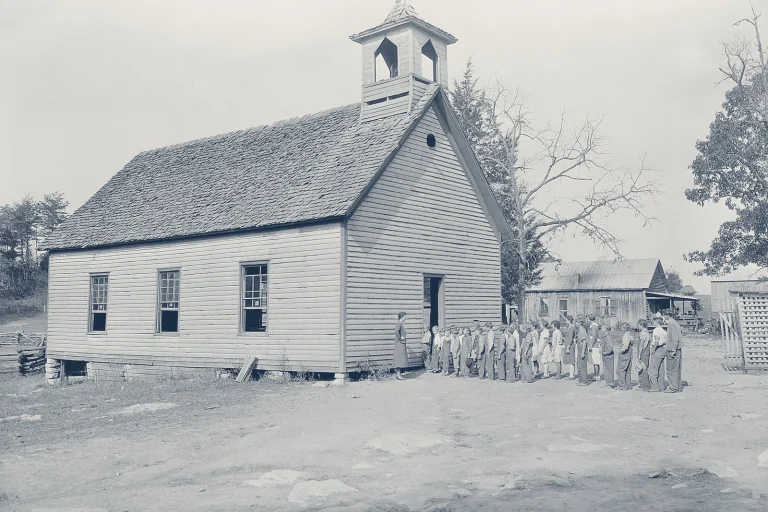
Featured image: Going to Sunday school at the Baptist church, Lejunior, Harlan County, Kentucky, September 15, 1946. Photo by Russell Lee, U.S. National Archives via Wikimedia Commons (public domain); duotone by Check the Claim.