Update (Nov. 16, 2026): Alabama voters approved Amendment 3 on Nov. 3, according to unofficial returns. Our follow-up: Alabama voters backed student-led school prayer. Was prayer ever banned? The post below is unchanged from before the vote.
On November 3, Alabama voters will see a short question on their ballots: Statewide Amendment 3. If it passes, every local school board in the state would have to adopt two policies. One would have each public K-12 school conduct the Pledge of Allegiance at the start of each school day. The other would allow prayer in public schools, as long as a student starts it and leads it and no student is required to join in.
The measure passed the legislature this spring with almost no opposition: 94 votes in the House and 30–0 in the Senate. Most of the attention has gone to the prayer part, so that’s what we’ll look at here.
The case for it
The sponsor, Rep. Reed Ingram (R-Pike Road), has been clear about what he wants and doesn’t want. “I’m not trying to cram religion down anyone’s throat,” he said after the House passed the bill in March, according to the Alabama Reflector. He said that “a lot of times, kids don’t have the option to pray and they don’t know what prayer means.” In comments quoted by The Conversationalist this month, he described it as “a voluntary basis, student-led only,” with no teacher or principal leading anything.
That’s a fair point worth taking seriously. Plenty of people grew up hearing that prayer was taken out of public schools, and confusion about what’s allowed is real enough that federal law makes school districts certify every year that they aren’t blocking it. The amendment’s text also includes real protections: the enrolled bill says “No student may be required to participate in a prayer,” and students can opt out of the pledge or the prayer “based on their own beliefs.”
What the record shows
Here’s the part that often gets lost: students in Alabama, and everywhere else in the country, can already pray at school.
The U.S. Supreme Court said so in plain words in 2000. In Santa Fe Independent School District v. Doe, a Texas case, the Court wrote that nothing in the Constitution “prohibits any public school student from voluntarily praying at any time.” In 2022, in Kennedy v. Bremerton School District, it went further and protected a high school football coach’s quiet personal prayer on the field after games.
The current federal government agrees. The U.S. Department of Education’s announcement of its 2026 guidance on prayer in schools says students “have a right to pray in school as an expression of individual faith, as long as they’re not doing so on behalf of the school.” The guidance itself also reminds districts that take federal education funds that federal law requires them to certify to their state every year that they have no policy blocking constitutionally protected prayer.
So what isn’t allowed? Prayer that the government sponsors. That line traces back to Engel v. Vitale (1962), when the Court struck down a prayer written by New York state officials for classrooms to recite. The Establishment Clause (the part of the First Amendment that bars the government from setting up or favoring a religion) governs what the school itself does. Students praying on their own are acting as private citizens.
Alabama knows this line well, because it has tested it before:
- 1981–1982: The legislature passed a moment of silence “for meditation or voluntary prayer,” then a law letting teachers lead “willing students” in a prayer. In Wallace v. Jaffree (1985), the Supreme Court struck down the first and affirmed that the second was unconstitutional. The 1981 bill’s sponsor, state Sen. Donald Holmes, testified that returning voluntary prayer to public schools was his only purpose.
- 1993: A new law allowed “non-sectarian, non-proselytizing student-initiated voluntary prayer” at assemblies, games and graduations. A federal judge blocked it in 1997, and the case (Chandler v. James) went back and forth through the courts until 2001, when the Supreme Court declined to hear it. The appeals court’s final word, as summarized by the Congressional Research Service: private prayer that is “genuinely student-initiated” is protected, even out loud.
Where Amendment 3 lands
That history points to the real question. A student praying on her own, or with friends before class, is already legal. The harder case is a prayer that happens because a school board policy says there will be one, in a classroom full of students who are required to be there.
The closest Supreme Court case is Santa Fe, where students voted on whether to have a pregame invocation and picked the student who’d deliver it. The Court said those prayers were “not properly characterized as ‘private’ speech” because the school had set up the whole process. Supporters can point to real differences: no schoolwide vote, an opt-out written into the text, and, as Ingram put it, “Nothing is going over the PA.” Ingram has also said a moment of silence wouldn’t do the same job: “We want the students to hear it.”
A few things are still unsettled:
- When the prayer happens. Several news reports say prayer would come at the start of the day. In the enrolled text, “at the beginning of each school day” appears in the pledge section; the prayer section doesn’t set a time. Local boards would fill in those details.
- How a court would see it. The amendment changes Alabama’s constitution, and federal law still sits above it. As the Alabama Reflector noted after both votes, it was unclear how the bill would “change or challenge existing law.” No lawsuit has been filed, since nothing has taken effect.
- What boards actually write. A policy that simply protects students who choose to pray looks very different from one that builds a daily, audible prayer into class time.
Why this matters
The belief that “they took prayer out of schools” is a widely shared idea in American religious politics, and it feeds a bigger story: that the country drifted from a Christian founding and needs government to bring God back. That story is at the heart of Christian nationalism, the idea that being truly American and being Christian are tied together and that the law should reflect it.
The record tells a narrower story. Courts left students’ freedom to pray in place and removed the government’s role in leading it. They’ve also defended students’ and coaches’ private prayer again and again. Whether you’d vote yes or no on Amendment 3, it helps to know that difference. We cover the longer history in our page on whether separation of church and state is in the Constitution, and another new Alabama school law in our post on the state’s Ten Commandments poster.
What to watch
- November 3: Alabama votes on Amendment 3, along with Amendment 4 on weekly playing of the national anthem.
- If it passes: Look at the policies local boards adopt, and whether anyone challenges them in court.
- Nationally: The Supreme Court is weighing whether to take up Ten Commandments cases from Texas and Louisiana, which raise the same basic question: where does a school’s role end and a student’s begin?
Sources
- Alabama Act 2026-379 (HB 511), enrolled text
- Alabama Fair Ballot Commission, Statewide Amendment 3
- Engel v. Vitale, 370 U.S. 421 (1962)
- Wallace v. Jaffree, 472 U.S. 38 (1985)
- Santa Fe Independent School District v. Doe, 530 U.S. 290 (2000)
- Kennedy v. Bremerton School District, 597 U.S. 507 (2022)
- U.S. Department of Education, press release on 2026 prayer guidance
- U.S. Department of Education, Guidance on Constitutionally Protected Prayer and Religious Expression (2026)
- Congressional Research Service, “The Alabama School Prayer Case: Chandler v. Siegelman”
- Alabama Reflector, House passage, March 11, 2026
- Alabama Reflector, Senate passage, April 8, 2026
- The Conversationalist, October 8, 2026
- Ballotpedia News, April 10, 2026
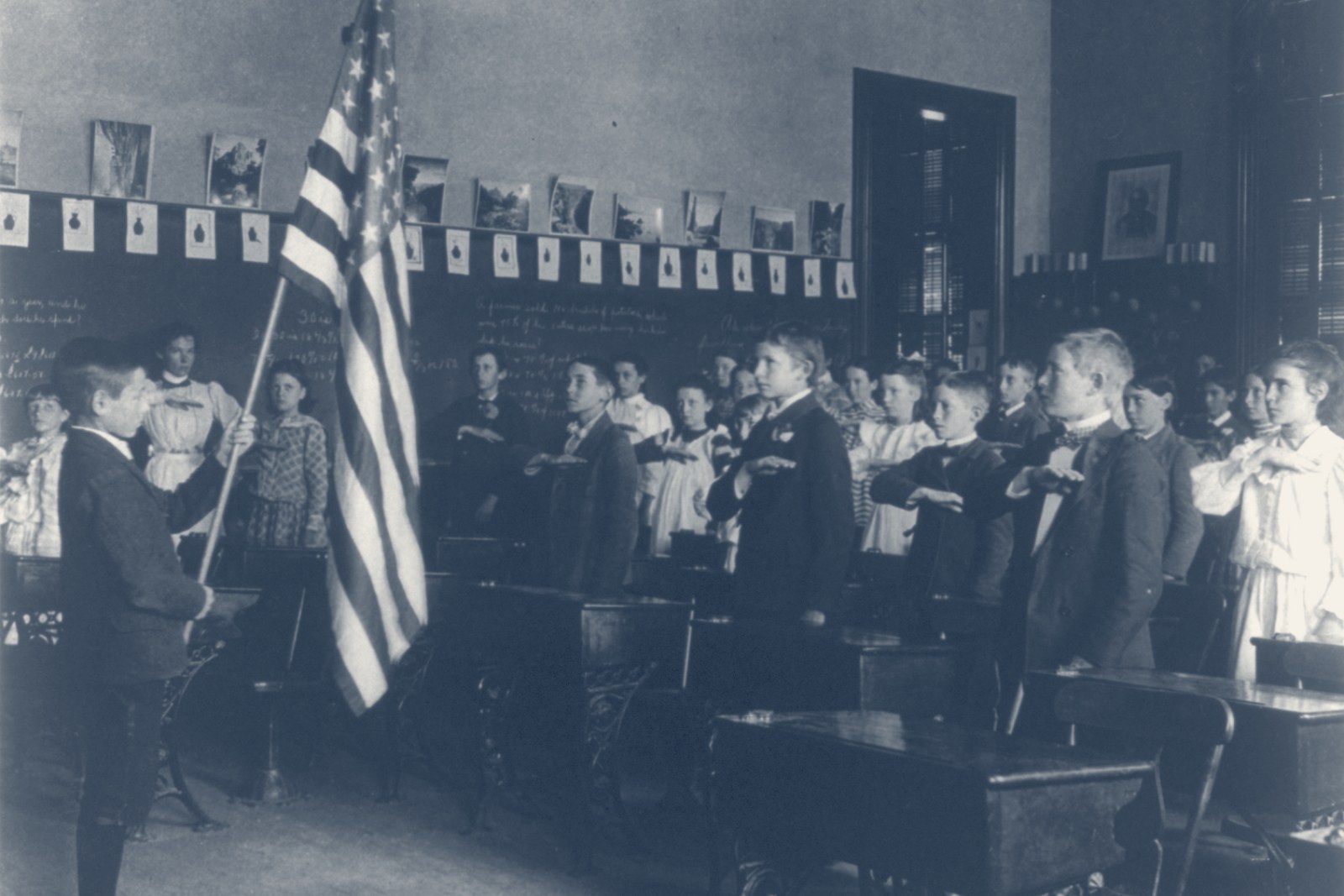
Image: Students pledging to the flag, Washington, D.C., 1899. Photo by Frances Benjamin Johnston, Library of Congress, digital ID cph.3a16954 (public domain), via Wikimedia Commons; duotone by Check the Claim.
Spotted an error? Tell us.